









-Welcome to our world- the real world of Farming and Agriculture in South Africa- Local and International news- (Farmingportal.-168,260 hits per minute)
This AGRI NEWS RUSH - Just that one Step Ahead -Some of the news stories of this week-, SUNDAY EDITION - ALWAYS ON TIME - AGRI NEWS RUSH is now one of the most read Articles on a Sunday
AGRI NEWS RUSH - HEADLINE NEWS OF THE WEEK - www.agrinewsnet.co.za
Minister of Agriculture Willie Aucamp has highlighted farmers and strong partnerships as central to the future of South Africa’s agricultural sector, following an event in Pretoria where he paid tribute to producers alongside AFGRI CEO Norman Celliers and the AFGRI team.
South Africa’s increasingly frequent weather extremes are now threatening crop yields just as much as pests and diseases, according to agricultural specialists.In the fields, the impacts are already clear. In Citrusdal, citrus orchards have experienced temperatures over 45°C, resulting in sunburn, fruit drop, oxidative stress and lower pack-out rates.
AgriSA, Agri Western Cape and the Canning Fruit Producers Association have called for urgent talks with Premier Group after the company announced plans to close the Tulbagh soft-fruit canning facility ahead of the 2026/27 harvest.
The global soybean market keeps growing, fueled by demand for food, animal feed and industrial use. Brazil, the US and Argentina remain the top producers, but Africa’s role in the value chain is steadily increasing.For Mozambique, the biggest opportunity may not just be growing soybeans.
Sea surface temperatures in the current El Niño are among the highest recorded since 1876. That year is when experts first started using the Southern Oscillation Index (SOI) to track these events. Unstable weather around the world is linked to this strong El Niño.
Blueberry season is starting well in South Africa’s northern regions. Growers in Limpopo, Mpumalanga and North West expect strong yields, good-quality fruit and solid export prices.In the Western Cape, which produces about half of the country’s blueberries, the outlook is more uncertain
Young farmers in the Western Cape are facing pressure from poor climate conditions, slow research response, rising input costs, and the challenge of keeping up with technology. Speaking at a conservation agriculture panel discussion in the province, two farmers said planning would be much easier if they could know in advance what the weather and producer prices will be in the future.
Zambia has partly lifted its ban on livestock imports from South Africa as the foot-and-mouth disease situation improves.The Ministry of Livestock and Fisheries said late Wednesday that imports of certain cloven-hoofed animals and animal products will now be allowed on a case-by-case basis,
South Africa’s overall public sector debt is far larger than the headline government figure, sitting at R10.94 trillion or 143.1% of GDP at the end of the 2025/26 financial year. That compares to government debt alone of R6.1 trillion, or 78.5% of GDP, after R534.1 billion in new borrowing last year.
A dangerous mix of severe cold, rain, snow and strong winds is expected from 9 to 11 August across central and southern parts of South Africa. Frost is also possible over several inland areas. Livestock farmers are advised to take precautions early to protect animals from exposure and possible deaths.
After a very challenging year in the Eastern Cape, there are signs of progress despite serious setbacks. The province was hit hard by devastating floods in the Gamtoos Valley and Langkloof in May, and by renewed foot-and-mouth disease outbreaks across the region.
Saffron is the world’s most expensive spice, selling for between $5,000 and $10,000 per kilogram. Iran dominates global production with about 85% to 90%, followed far behind by Afghanistan and India. South Africa is not a major producer, but its arid regions are considered suitable for growing it.
South Africa’s overall public sector debt is far larger than the headline government figure, sitting at R10.94 trillion or 143.1% of GDP at the end of the 2025/26 financial year. That compares to government debt alone of R6.1 trillion, or 78.5% of GDP, after R534.1 billion in new borrowing last year.
Strong institutions are a hidden strength in South Africa that does not get enough recognition, said Prof. Ferdi Meyer, executive director of the Bureau for Food and Agricultural Policy (BFAP). Speaking at a Protein Research Foundation (PRF) meeting on the way forward for the oilseeds industry, he noted that you only realize how fortunate South Africa is with its strong institutions when you work elsewhere.
A kilogram of coffee sold as capsules in Germany retails for €35.98. The farmer who grew it receives 6%. Sell the same coffee ground, at €8.06 per kilogram, and the farmer's share nearly quadruples to 24%. Same cherries. Same estate. Same years of growth before first harvest. The only thing that changed is packaging format, and it rewrote who captures the value.
South Africa posted a preliminary trade surplus of R17.8 billion in June, as exports rose and imports fell compared to May, according to SARS data that includes trade with Botswana, Eswatini, Lesotho and Namibia.Exports increased to R193.6 billion, while imports dropped to R175.8 billion
If you are using our content in your media coverage or on any agricultural radio programme, we would greatly appreciate it if you could credit the source. We understand how valuable and convenient this information can be—especially on a Monday morning after a weekend of NO WORK .
- Weaner calf: ≈ R49.97/kg
- A2/A3 (Super): ≈ R70.80 – R72.05/kg
- B2/B3: ≈ R66.05/kg
- C2/C3: ≈ R60.67 – R63.03/kg
- Feeder / Speenlam: ≈ R56.86 – R59.54/kg
- A2/A3: ≈ R108.86 – R110.80/kg
- B2/B3: ≈ R83.87/kg
- C2/C3: ≈ R79.40 – R81.74/kg
- Baconers: ≈ R27.81 – R29.08/kg
- Porkers: ≈ R26.90 – R30.42/kg
- Frozen whole bird (ex-abattoir): ≈ R32.51/kg
- Fresh whole bird: ≈ R37.73/kg
- IQF: ≈ R34.42/kg
- Beef and lamb remain relatively firm, supported by tighter supplies in some categories.
- Pork prices have eased after earlier disease-related disruptions and increased supply.
- Chicken prices continue a mild downward trend amid improved production and lower feed costs in recent months.
- Yellow maize (key feed cost) was around R3 699/ton (6 August).

- Aug 26: ~R3,395 (down ~R13)
- Sep 26: ~R3,436 (down ~R18)
- Dec 26: ~R3,570 (down ~R10)
- Nearby levels in the mid-to-high R3,300s–R3,500s range amid ample supply.
- Aug 26: ~R3,428 (down ~R19)
- Sep 26: ~R3,475 (down ~R18)
- Dec 26: ~R3,611 (down ~R7)
- Trading slightly above white maize in many contracts; export parity remains a key anchor.
- Aug 26: ~R5,940 (down ~R10)
- Sep 26: ~R5,975 (down ~R17)
- Dec 26: ~R6,019 (down ~R9)
- Relatively stable to softer; influenced by international parity and Black Sea logistics issues.
- Aug 26: ~R10,210 (up ~R92)
- Sep 26: ~R10,263 (up ~R73)
- Dec 26: ~R10,399 (up ~R96)
- Stronger session with gains of R70–R100+ on active contracts.
- Sep 26: ~R6,966 (up ~R15)
- Nov 26: ~R7,139 (up ~R49)
- Other contracts quieter/flat in the R7,000–R7,400 area.

50 Key South African Headline News Stories in Agriculture, Farming & Agritech 7th Augustus 2026
- South Africa Plants Smallest Wheat Area Since 1929 Amid Dry Western Cape Conditions
- Intensifying El Niño Raises Risk of Hotter, Drier 2026/27 Summer Season
- Foot-and-Mouth Disease Remains National Concern Across Multiple Provinces
- OBP Vaccine Distribution Costs Under Parliamentary Scrutiny
- Free State Agriculture President Warns Primary Producers Under Severe Pressure
- Agricultural Sector Records 3.9% Growth in First Quarter of 2026
- Red Meat Exports Reach 81 000 Tonnes Worth R63 Billion
- SAFLA and AMIE SA Sign Cooperation Pact to Tackle Port Bottlenecks
- Driest July on Record Hits Parts of Southwestern Western Cape
- Farmers Face Rising Input Costs Linked to Global Fertilizer Volatility
- Land Reform and Title Deed Release Progress Highlighted in Government Drive
- Severe Weather and Hail Drive Insured Crop Losses Above R1 Billion
- Highveld and Free State Farmers Battle Frost and Fire Danger Risks
- Winter Wheat Crop Outlook Clouded by Below-Normal Rainfall
- Border Control Failures Fuel Livestock Movement and Disease Spread Concerns
- Expropriation Act Court Challenges Continue in Western Cape High Court
- Primary Producers Contribute Only 2–7% of Broader Agricultural GDP
- Crumbling Free State Roads Force Farmers to Repair Infrastructure Themselves
- Private Sector Gains Direct Access to FMD Vaccines Under Settlement Deal
- Neighbouring Countries Receive 50 000 Doses of FMD Vaccine Each
- Western Cape Wildflower Season Starts Early After Generous Rains
- Namaqualand and West Coast Blooms Attract Tourists and Boost Local Economy
- Grain Farmers Prepare for 2026/27 Summer Planting Amid El Niño Warnings
- Soil Moisture Levels Offer Temporary Buffer Against Expected Dry Conditions
- Fertiliser Prices Remain Elevated Despite Some Global Easing
- Logistics Delays at Durban Port Continue to Hamper Meat Exports
- Veterinary Approvals and Cold-Chain Capacity Still Major Trade Constraints
- Farm Safety and Crime Remain Persistent Challenges for Rural Communities
- Precision Agriculture and Hail Nets Gain Ground as Climate Adaptation Tools
- Crop Insurance Claims Surge Amid Increasing Weather Volatility
- Agricultural Exports to Africa Face New Import Restrictions from Neighbours
- SACU Trade Tensions Threaten Regional Vegetable and Fruit Flows
- Government Urged to Speed Up Title Deeds for Emerging Farmers
- Livestock Producers Struggle with High Production Costs and Low Farm-Gate Prices
- Poultry Industry Claims Strong Competitiveness Against International Rivals
- Maize Stocks Remain Healthy After Strong Previous Harvest
- Smart Irrigation Technologies Help Farmers Maximise Fertiliser Efficiency
- Youth-Led Poultry and Broiler Projects Expand in Limpopo
- Apple Exports Strengthen Brand Loyalty in Chinese Markets
- Climate Resilience Strategies Top Agenda at Provincial Agriculture Congresses
- Free State Agriculture Annual Congress Focuses on Producer Sustainability
- Agri Eastern Cape and Agri Limpopo Host Key Industry Gatherings
- Water Conservation Calls Intensify Ahead of Potential Dry Summer
- Illegal Livestock Movement Across Borders Raises Biosecurity Alarms
- Natural Border Barriers Preferred Over Fencing Along Lesotho Frontier
- Women’s Voice in Agriculture Celebrates Innovation and Leadership
- AI-Ready Data and Digital Tools Highlighted as Future Farming Needs
- GMO and Precision Farming Debated as Tools to Lower Food Prices
- Emerging Farmers Seek Fair Input and Output Prices for Viability
- Industry Leaders Call for Coordinated Action on Logistics, Disease and Climate Risks

READ MORE ( Stats) Listen to all our Daily Audiocast - It is doing very good. But also see that some news mediums like to follow us.
MORE GOOD NEWS - AUDIO AGRI NEWS NET which was selected by Million Podcasts as one of the Top 100 Agriculture Podcasts, Top 100 Farming Podcasts and Top 100 Sustainable
Agriculture Podcasts on the web. READ MORE


WATCH OUT- NEW program on the way - exclusive to CRA MEDIA and the FARMERS of South Africa - 2026


DISCLAIMER
The views and opinions expressed in this program are those of the writers and do not necessarily reflect the views or positions of any entities they represent. The information contained in this website is for general information purposes only. The information is provided by CRA and while we endeavour to keep the information up to date and correct, we make no representations or warranties of any kind, express or implied, about the completeness, accuracy, reliability, suitability or availability with respect to the website or the information, products, services, or related graphics contained on the website for any purpose. Any reliance you place on such information is therefore strictly at your own risk.Just for your information. - We need to share this as this is part of Farming and Agriculture.
AGRI NEWS NET stands as South Africa’s leading source for farming and agriculture news, delivering trusted, up-to-date content 7 days a week, 365 days a year. With over 50 “good news stories you can trust,” the platform is driven by 30 years of practical farming and media experience, ensuring a deep understanding of the needs and realities of farmers and the agricultural sector. AGRI NEWS NET prides itself on being committed, independent, focused, and always on time. As part of the CRA Group, the platform leverages its extensive expertise to provide reliable, farmer-centric news. Its content is compiled using advanced AI technology, ensuring accuracy and relevance while staying connected to the broader global farming and agriculture community. For the third consecutive year, AGRI NEWS NET’s Daily Audiocast has been ranked among the top 15 agricultural podcasts on Feedspot, a testament to its quality and impact. The audiocast delivers concise, engaging updates, making it a go-to resource for farmers, industry professionals, and agriculture enthusiasts seeking timely insights. With a focus on “good news stories,” AGRI NEWS NET highlights positive developments, innovations, and successes in South African agriculture. Rooted in real-world farming knowledge and media expertise, AGRI NEWS NET bridges the gap between farmers, policymakers, and the public. Its AI-driven platform ensures comprehensive coverage, from local issues . By focusing on practical, trustworthy content, AGRI NEWS NET empowers the agricultural community to stay informed and inspired.
- Major systems remain healthy: The Integrated Vaal River System (key for Gauteng) and large Orange River dams continue to hold high levels.
- Vaal Dam (week of 3–9 August): Averaged 101.16% (ranged 101.00–101.26%). Inflows averaged ~38.6 m³/s; discharge steady at 16.8 m³/s. Slightly below the same period last year (~106%).
- Seasonal pattern: Interior/summer-rainfall provinces are mostly near or above full capacity and easing slowly. Western Cape (winter-rainfall) is still filling but lags last year in the Cape Town system.
- Western Cape: Provincial average ~79.5% (slightly up week-on-week in some reports). Cape Town system dams combined ~77.6% (down from ~84.5% last year). Theewaterskloof ~77.8%; other system dams mixed (e.g., Upper Steenbras near full, Lower Steenbras lower).
- Mpumalanga: Provincial average declined to 98.4% (from 98.7%). Many Lowveld dams steady near or above 100%; some declines elsewhere (e.g., Grootdraai).
- KwaZulu-Natal: Provincial total ~87.5% (down from ~96.6% last year). Examples: Albert Falls ~89%, Inanda ~97%, Goedertrouw ~93%.
- Eastern Cape: Provincial total ~89% (better than ~82% last year in some comparisons). Mixed individual dams; Algoa system reported near full in related updates.
- Northern / Interior provinces (Limpopo, North West, Free State, Gauteng areas): Generally very high (many individual dams 95–105%+), with only minor weekly declines.
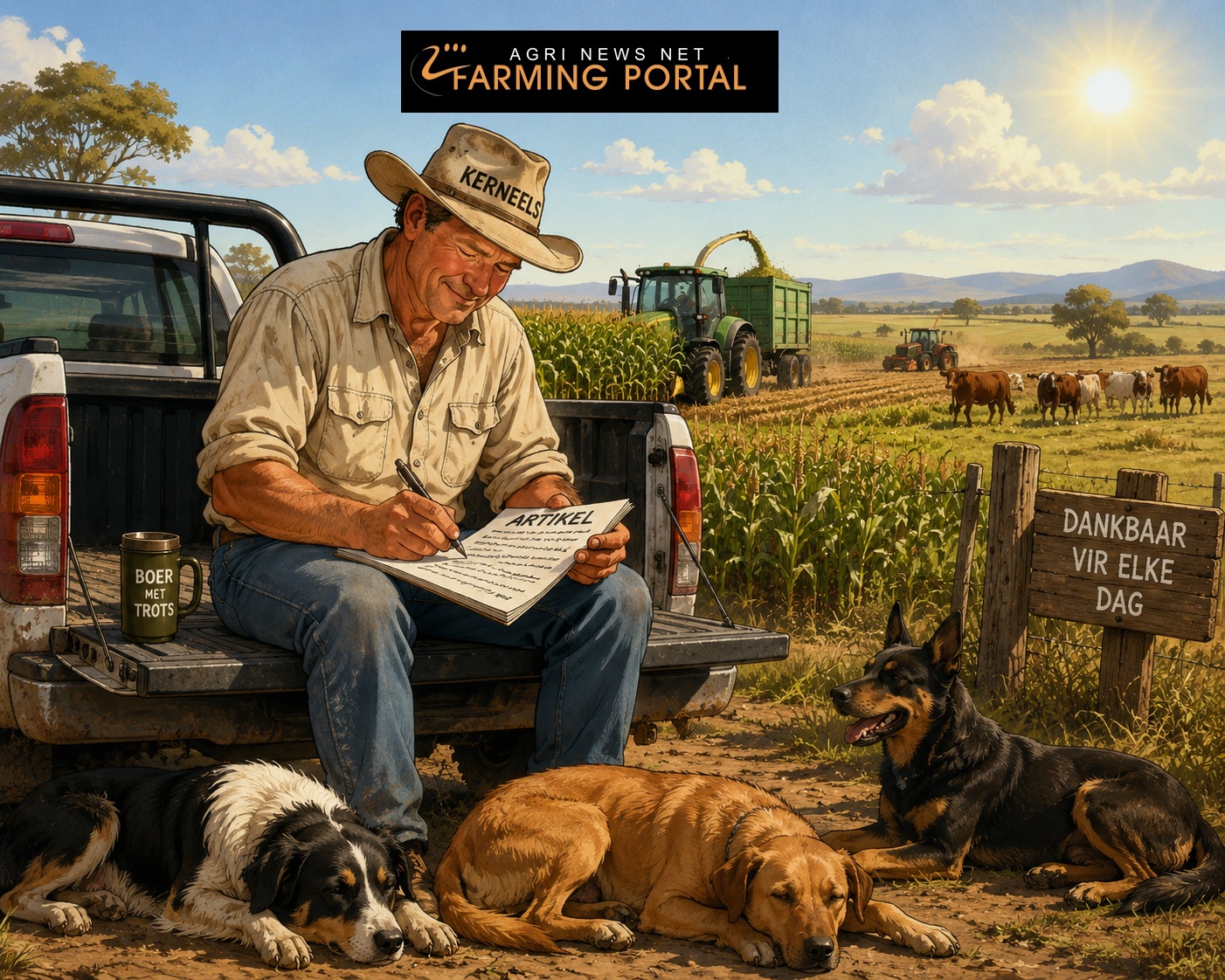
OOM KERNEELS
Van die Plaas af:
Elke week sit ek en probeer my gedagtes op papier kry. En elke week is hulle weer weg. Ek dink dis omdat die wêreld te vinnig draai. Daar is net te veel mense daar buite wat vir ons wil vertel hoe dinge werk — en meeste van hulle het nog nooit ‘n pit in die grond gesit nie..Ek kyk so nou en dan saam met Getruida Televisie. Maar dit raak al hoe meer banaal.
Die Afrikaanse kanale herhaal dieselfde stories, en nou vloek hulle ook sommer lekker saam. Daar is een ding wat jy nie moet verloor nie: selfrespek en jou waardes. En saam daarmee loop tradisie.
Die All Blacks is hier in die land. Ek moet eerlik sê, in die bietjie wat ek gesien het, lyk hulle nie vir my soos die rugby-manne van vroeër nie.
Tog is die mense weer eens rugby-mal. So gaan dit maar. En die Springbokke het amper hulle wedstryd verloor — dit was ‘n duur oefening daar in die buiteland.
My broer se kind trou eersdaags. Mense nooi baie graag hulle beste vriende. Maar as van hulle daarop aandring dat daar ‘n televisie moet wees om rugby te kyk, dan is hulle nie jou vriende werd nie.
Wat wel my aandag getrek het, is die nuwe Minister van Landbou. Jy sien hom oral. Hy praat, hy luister, hy staan tussen die mense. En jy sien sommer daai paar manne wat skielik baie belangrik voel as hy by hulle is. Dit lyk of ons die bek en klouseer 'n hou begin toedien. Die man is doener.
Op my foon lewe ek deesdae op WhatsApp. Maar ek sien al hoe meer mense skakel daai blou merkies af. Jy weet mos, dié wat vir jou sê “ek het jou boodskap gelees”. As jy dit afskakel, dan weet jy dis ‘n wegkruiper.
By die huis is ons klaar met mielies stroop. Die geld was in die bank... en toe was dit weer uit. En voor ons lê nog ‘n nuwe jaar. Maar ons hou moed. Dit kan nie net sleg gaan nie.Ek het iets vir myself uitgewerk hierdie week: Ons plaas nie meer geld oor nie. Ons plaas syfers oor. Want geld is daar nie meer nie.
Vandag is vrouedag- waardeer jou vrou en ander wat dit tog so lekker maak om te lewe- Wie weet dalk kry ons manne ook 'n spesiale dag iewers-
Ons moet wakker word. Die manne met die groot dik brille kom vertel vir ons net wat ons wil hoor .Boer voort, hou kop, en onthou: die mense wat die minste skree, is gewoonlik die wat die meeste werk. Tot volgende week.
Mag julle almal ’n lekker week he ons gesels weer. OOM Kerneels.
NS -We normally do not post sponsored or external videos on our professional platforms. However, videos of this nature — which are non-marketing and informative — are not freely available YouTube channels. We will soon have our own Professional Video Channel form our own Production house.


