







-Welcome to our world- the real world of Farming and Agriculture in South Africa- Local and International news- (Farmingportal.-172,106 hits per minute) Readers per week- 16,789
 This AGRI NEWS RUSH - Just that one Step Ahead -Some of the news stories of this week-, SUNDAY EDITION - ALWAYS ON TIME - AGRI NEWS RUSH is now one of the most read Articles on a Sunday
AGRI NEWS RUSH - HEADLINE NEWS OF THE WEEK - www.agrinewsnet.co.za
Willie Aucamp, Minister of Agriculture, argued that instead of debating the merits of broad-based Black Economic Empowerment (B-BBEE), the focus should shift to finding practical ways to achieve measurable transformation and meaningful participation in the agricultural sector.
The AgriSA announcement came as global and local scrutiny of farm attacks reached new highs following a seminar and protest action in Washington DC that commemorated the deaths of more than 3 000 South African farmers. AgriSA pointedly did not support that commemoration and published media critical of it.
Recent good rains have improved soil moisture and given South Africas summer grain farmers a better start, but the El Niño risk for the 2026/27 season remains. Planting in the east usually starts mid-October and in the west mid-November, although some producers may start earlier due to better moisture.
Setting geopolitics aside and focusing purely on trade data, South Africa’s relationship with BRICS is significant but unbalanced.In 2025, BRICS+ accounted for roughly 19% of South Africa’s exports and 36% of its imports. Total trade reached about US$62 billion, yet South Africa exported only around US$23.2 billion while importing approximately US$38 billion.
China, Thailand and Japan were among the top ten exporters to South Africa in 2025 according to TradeInt data. China ranked first with about $23.8bn or 22.46% of total imports, Thailand sixth with $3.5bn or 3.27% and Japan with $2.4bn or 2.31%, together accounting for roughly $37.3bn.
Die NOK het die kommersiële mielie-oes met 0,7% opwaarts aangepas tot 17,523 miljoen ton - die grootste oes op rekord - danksy n sterk witmielie-oes veral in die westelike gebiede. Geelmielies bly onveranderd op 7,91 miljoen ton.
The private vaccine manufacturer Design Biologix wants to apply to manufacture foot-and-mouth disease (FMD) vaccines and says it could produce the entire country's FMD vaccine within a year if given the opportunity.
At a Nedbank-hosted media event at NAMPO Cape, stakeholders from across the agricultural value chain discussed what it will take to move farmers from conventional to regenerative agriculture. The clear message was that if regenerative agriculture is to move from pockets of adoption to scale, the conversation needs to change.
Zimbabwe accounted for 8% of South Africa's total fruit and vegetable exports in 2025, making it one of SA's main agricultural markets.South African agricultural exports to Zimbabwe were valued at US$1.2 billion in 2025, equal to the value shipped to the Middle East and BRICS members.
South Africa's meat sector is a significant part of the agricultural economy. Industry researcher IMARC values the market at $6.5 billion, almost R106 billion today, with a projection to grow to $7.8 billion by 2034. That growth is being driven by urbanisation and rising demand for protein-rich food.
President Cyril Ramaphosa says it is neither responsible nor patriotic to travel abroad and spread the lie of a "white genocide" and thereby discourage investment in South Africa. This comes amid high levels of unemployment and the country's need for economic growth and investment.
Predictions of a “super-El Niño” have sharply lifted grain prices on futures markets, but the recent surge is being driven more by fear and speculation than by hard market fundamentals. Producers and buyers now need to protect margins and make planting decisions that limit risk.
.
If you are using our content in your media coverage or on any agricultural radio progr
amme, we would greatly appreciate it if you could credit the source. We understand how valuable and convenient this information can be—especially on a Monday morning after a weekend of NO WORK .
|
Category
|
Price (R/kg)
|
|---|---|
|
Weaner calf (live)
|
50.35
|
|
Class A2/3
|
65.51
|
|
Class B2/3
|
58.97
|
|
Class C2/3
|
56.77
|
|
Category
|
Price (R/kg)
|
|---|---|
|
Feeder lamb (live)
|
53.40
|
|
Class A2/3
|
108.57
|
|
Class B2/3
|
88.87
|
|
Class C2/3
|
87.87
|
|
Category
|
Price (R/kg)
|
|---|---|
|
Porkers
|
29.12
|
|
Baconers
|
28.89
|
- Frozen whole bird: ≈ R32.08/kg
- Fresh whole bird: ≈ R35.53/kg
- IQF portions: ≈ R30.44/kg

|
Commodity
|
Price (R/tonne)
|
Daily change
|
|---|---|---|
|
White maize
|
4 058
|
+22
|
|
Yellow maize
|
4 085
|
+25
|
|
Wheat
|
6 024
|
+3
|
|
Sunflower seed
|
10 078
|
+69
|
|
Soybeans
|
9 241
|
+47
|
- White maize: R3 900–4 150/t
- Yellow maize: R3 950–4 160/t
- Wheat: R5 900–6 200/t
- Sunflower: R9 900–10 250/t
- Soybeans: R8 950–9 200/t
- Large local carry-over stocks and a strong previous harvest are capping prices.
- International maize and soybean markets have been firmer on tighter U.S. supply prospects.
- Potential El Niño weather risks for the upcoming season are beginning to feature in forward pricing.
- The rand and import/export parity levels remain important local drivers.

- South Africa’s 2026/27 wheat crop forecast at 1.81 million tonnes – an eight-year low due to reduced plantings and dry weather in the Western Cape.
- Wheat imports expected to rise to around 2 million tonnes.
- Total winter crops (wheat, barley, canola, oats, lupines) estimated at 2.67 million tonnes, up 2% year-on-year.
- Table grape export estimate for 2026/27 stabilised at 78.4 million cartons (range 76.8–79.9 million).
- Table grape season expected to start 10–14 days earlier due to warmer weather.
- Dam levels in main table grape regions average about 82% full.
- El Niño confirmed as strong and likely to intensify, with below-normal rainfall and above-normal temperatures forecast for most of South Africa from October 2026.
- Farmers advised to prepare for drier conditions, soil-moisture conservation and adjusted planting windows.
- Agribusiness Confidence Index jumped 8 points to 53 in Q3 2026 – first time above neutral this year.
- Agricultural exports reached $7.8 billion in the first half of 2026 (up 11%) and $4.1 billion in Q2 alone (up 10%).
- Record summer grain and oilseed harvest of around 21.6 million tonnes confirmed for 2025/26 season.
- Maize crop estimated at a record ~17.4–18 million tonnes.
- Consumer food price inflation remained very low at 0.6–0.7% in July/August 2026 – lowest levels since 2010.
- Foot-and-mouth disease (FMD) remains a major challenge; government targeting 80% national herd vaccination by December.
- More than 21–23 million FMD vaccine doses imported or produced so far (mainly from Turkey and Argentina).
- Proposal approved for private companies to manufacture ARC FMD vaccine under licence to boost local supply.
- Western Cape welcomes expanded private-sector FMD vaccine production.
- Egypt opens its market to South African red meat after successful Veterinary Health Certificate negotiations.
- China opens market for South African cherries; blueberry protocol expected later in 2026.
- Exporters increasingly targeting China and other BRICS markets amid global trade shifts.
- Agriculture Minister Willie Aucamp urges faster rollout of the Agriculture and Agro-processing Master Plan and more private investment.
- Blended-finance programmes have approved about R98 billion since inception.
- Land Bank temporarily pauses new applications for its blended finance scheme after strong demand exhausted 2026/27 grant funding.
- Eskom has lost more than 13 000 agricultural customer accounts over the past decade, but agriculture’s revenue contribution still grew to R17.4 billion.
- Port inefficiencies (especially Cape Town) forced some exporters to shift volumes to the Eastern Cape.
- Citrus industry faces oversupply challenges, particularly with a massive lemon crop.
- Pink Lady apple shipments to Europe and the UK continue strong growth (UK volumes up >16%).
- South Africa supplies about 80% of Southern Hemisphere Pink Lady apples.
- Regenerative farming discussed as a way to build climate resilience at Nampo Cape.
- Farmers urged to understand market cycles, plan ahead and invest in technology to stay competitive.
- Canola, sheep and wool showing upward price trends; wheat under pressure.
- Wool prices up about 60% year-on-year by August 2026.
- Lamb prices strengthened to around R111/kg.
- Grain SA approved 10 new cultivars that could increase yields by more than 10%.
- Input costs for wheat farmers have risen significantly faster than farmgate prices over the past decade.
- National wheat area planted in 2026 fell to the smallest since 1929 in some reports.
- Stockfarm and Veeplaas October 2026 issues focus on livestock water management ahead of expected El Niño.
- New-generation vaccine for orf (scabby mouth) under development.
- World Rabies Day highlights need for dog vaccinations to protect both animals and people.
- Royal Show 2026 scheduled for 7–11 October in Howick (moved due to earlier FMD concerns).
- TLU SA marks 129 years and reaffirms focus on protecting commercial farmers’ interests.
- Concerns raised about proposed EU pesticide regulation changes and their impact on South Africa.
- South African pesticide laws (dating to 1947) remain outdated while highly hazardous pesticides phase-out is discussed.
- SANRAL extending routine road maintenance contracts amid procurement rebuilding.
- Calls for modern signalling, infrastructure monitoring and better coordination across mines, rail and ports to improve freight.
- “Road to Recovery” farmer discussion on foot-and-mouth disease impact planned at Nampo Alfa.
- Strong demand for protein-enhanced food products continues despite most consumers already meeting protein needs.
- Agricultural sector seen as a potential buffer against broader economic slowdown thanks to bumper harvests.
- Ongoing focus on rural safety, property rights, water and economic policy by organised agriculture.
- Farmers preparing for the start of the 2026/27 summer planting season (mid-October) under El Niño uncertainty.
These reflect the dominant themes right now: strong 2025/26 harvest benefits, rising El Niño risks for the new season, ongoing FMD management, export market expansion (especially Asia and BRICS), and structural challenges around costs, logistics and regulation.

READ MORE ( Stats) Listen to all our Daily Audiocast - It is doing very good. But also see that some news mediums like to follow us.
MORE GOOD NEWS - AUDIO AGRI NEWS NET which was selected by Million Podcasts as one of the Top 100 Agriculture Podcasts, Top 100 Farming Podcasts and Top 100 Sustainable
Agriculture Podcasts on the web. READ MORE
- Overall storage: 99.7% (up strongly from 96.7% the previous week, as of late September)
- Vaal Dam: 105.3% (later daily readings 28 Sep–1 Oct showed 106.8–106.9%)
- Bloemhof Dam: 109.0%
- Grootdraai Dam: 102.9%
- Sterkfontein Dam: 98.8%
- Mohale Dam (Lesotho Highlands): 104.7%
- Katse Dam: 86.3%
- Free State: Very strong – average around 101–106.7%. Many dams (including Gariep) at or above 100%, with some overflow reported after recent rains.
- Western Cape (province): ≈ 81.2–81.8%
- Cape Town Water Supply System (six main dams): ≈ 75.5–75.7% (slightly down week-on-week)
- Mpumalanga: ≈ 98–99% (most dams above 100%, a few lower)
- Limpopo: ≈ 98%
- Eastern Cape: ≈ 94–96%
- Northern Cape: ≈ 89%
- KwaZulu-Natal: ≈ 88%
- Systems supplying Gauteng: Strong, driven by the Vaal system.
|
Dam
|
Level (%)
|
|---|---|
|
Theewaterskloof
|
≈ 75.8–76
|
|
Voëlvlei
|
≈ 58–59
|
|
Berg River
|
≈ 94
|
|
Wemmershoek
|
≈ 87–89
|
|
Upper Steenbras
|
≈ 95–96
|
|
Lower Steenbras
|
≈ 48
|
|
Combined system
|
≈ 75.5–75.7
|

(As of early October 2026)South AfricaSouth Africa continues to battle its largest FMD epidemic on record. The disease has spread beyond traditional control zones and affected multiple provinces over recent years, leading to the loss of FMD-free without vaccination status.
- Current situation: Active cases persist. In the Free State alone, provincial authorities reported a total of approximately 799 confirmed cases by late September 2026, with around 155 still active and under quarantine (644 resolved). New clinical cases continue to be detected (e.g., one in the Fauresmith area in late September). Cases have been recorded across at least 19 local municipalities in that province.
- Control measures: Strict movement controls, quarantine of infected and linked properties, and a national risk-based vaccination campaign remain in force. National control measures published in July 2026 guide responses.
- Vaccination progress: Approximately 21 million doses have been imported or produced in 2026 (mainly from Turkey and Argentina, plus smaller volumes from Botswana and the Agricultural Research Council). About 19 million doses have been distributed. Nearly all of the country’s ~1.4 million dairy cows have received at least one dose. In the Free State, more than 1.66 million cattle have received a first vaccination.
- Vaccine production: The Agricultural Research Council (ARC) is expanding local capacity. In September 2026, approval was given for private companies to manufacture the ARC vaccine under conditional intellectual-property licensing to boost supply. South Africa needs an estimated 25 million doses annually for full twice-yearly coverage of the national herd.
- Trade impact: Exports remain heavily constrained. The industry is shifting toward a long-term strategy of FMD-free status with vaccination. The disease has cost the cattle sector billions of rands.
- Outbreak details: Detected during routine surveillance on a commercial farm in the Karasburg State Veterinary District (//Kharas Region, south of the Veterinary Cordon Fence). Ten of 11 samples tested positive; 63 cattle showed clinical signs.
- Immediate response: Nationwide suspension of movement, marketing, slaughter, import and export of all cloven-hoofed animals (cattle, sheep, goats, pigs, game) and their products.
- WOAH status: FMD-free status for the southern zone was revoked effective 22 September 2026. This halted exports to key markets including the EU, China, the United States, Norway and South Africa.
- Current containment (as of late September): Intensified surveillance and traceability indicated the outbreak remains localised to the //Kharas Region. Livestock that had moved from the infected farm to Otjozondjupa tested negative.
- Restrictions north of the Veterinary Cordon Fence were lifted.
- Limited easing occurred south of the fence (excluding //Kharas), including some stored raw meat at registered facilities.
- Movement from south to north of the fence remains restricted.
- Pork slaughter and trade stayed suspended nationwide longer, contributing to shortages and price spikes.
- Economic impact: The livestock sector (≈3.1% of GDP) faces significant losses in export revenue and employment. Estimates of potential job losses run into the thousands of job-years.
- Outbreaks have been reported in specific disease-control zones (notably Zones 3c and 6b) earlier in 2026.
- Vaccination campaigns continue in affected areas (e.g., thousands of cattle vaccinated in targeted zones, with booster rounds planned).
- Movement restrictions remain in place in certain zones. Export and transit of cloven-hoofed animals and fresh products are generally prohibited nationwide except in designated free zones (e.g., Zone 2 in some reports).
- Precautionary measures have been taken in response to outbreaks in neighbouring South Africa (including the Northern Cape), such as temporary suspension of certain feed imports.

- Urea (46%): R11 315/t (down 17.4% month-on-month)
- LAN (28%): R11 181/t (down 18.4% month-on-month)
- MAP: R19 610/t (up 11.6% month-on-month)
- Potassium Chloride (granular): R9 688/t (down 23.9% month-on-month)
Input cost pressure remains significant for the 2026/27 summer crop. Farmers are advised to time purchases carefully where possible. Diesel and fertiliser costs locked in during the current period will heavily influence the profitability of the crop harvested in 2027.

DISCLAIMER
The views and opinions expressed in this program are those of the writers and do not necessarily reflect the views or positions of any entities they represent. The information contained in this website is for general information purposes only. The information is provided by CRA and while we endeavour to keep the information up to date and correct, we make no representations or warranties of any kind, express or implied, about the completeness, accuracy, reliability, suitability or availability with respect to the website or the information, products, services, or related graphics contained on the website for any purpose. Any reliance you place on such information is therefore strictly at your own risk.Just for your information. - We need to share this as this is part of Farming and Agriculture.
AGRI NEWS NET stands as South Africa’s leading source for farming and agriculture news, delivering trusted, up-to-date content 7 days a week, 365 days a year. With over 50 “good news stories you can trust,” the platform is driven by 30 years of practical farming and media experience, ensuring a deep understanding of the needs and realities of farmers and the agricultural sector. AGRI NEWS NET prides itself on being committed, independent, focused, and always on time. As part of the CRA Group, the platform leverages its extensive expertise to provide reliable, farmer-centric news. Its content is compiled using advanced AI technology, ensuring accuracy and relevance while staying connected to the broader global farming and agriculture community. For the third consecutive year, AGRI NEWS NET’s Daily Audiocast has been ranked among the top 15 agricultural podcasts on Feedspot, a testament to its quality and impact. The audiocast delivers concise, engaging updates, making it a go-to resource for farmers, industry professionals, and agriculture enthusiasts seeking timely insights. With a focus on “good news stories,” AGRI NEWS NET highlights positive developments, innovations, and successes in South African agriculture. Rooted in real-world farming knowledge and media expertise, AGRI NEWS NET bridges the gap between farmers, policymakers, and the public. Its AI-driven platform ensures comprehensive coverage, from local issues . By focusing on practical, trustworthy content, AGRI NEWS NET empowers the agricultural community to stay informed and inspired.

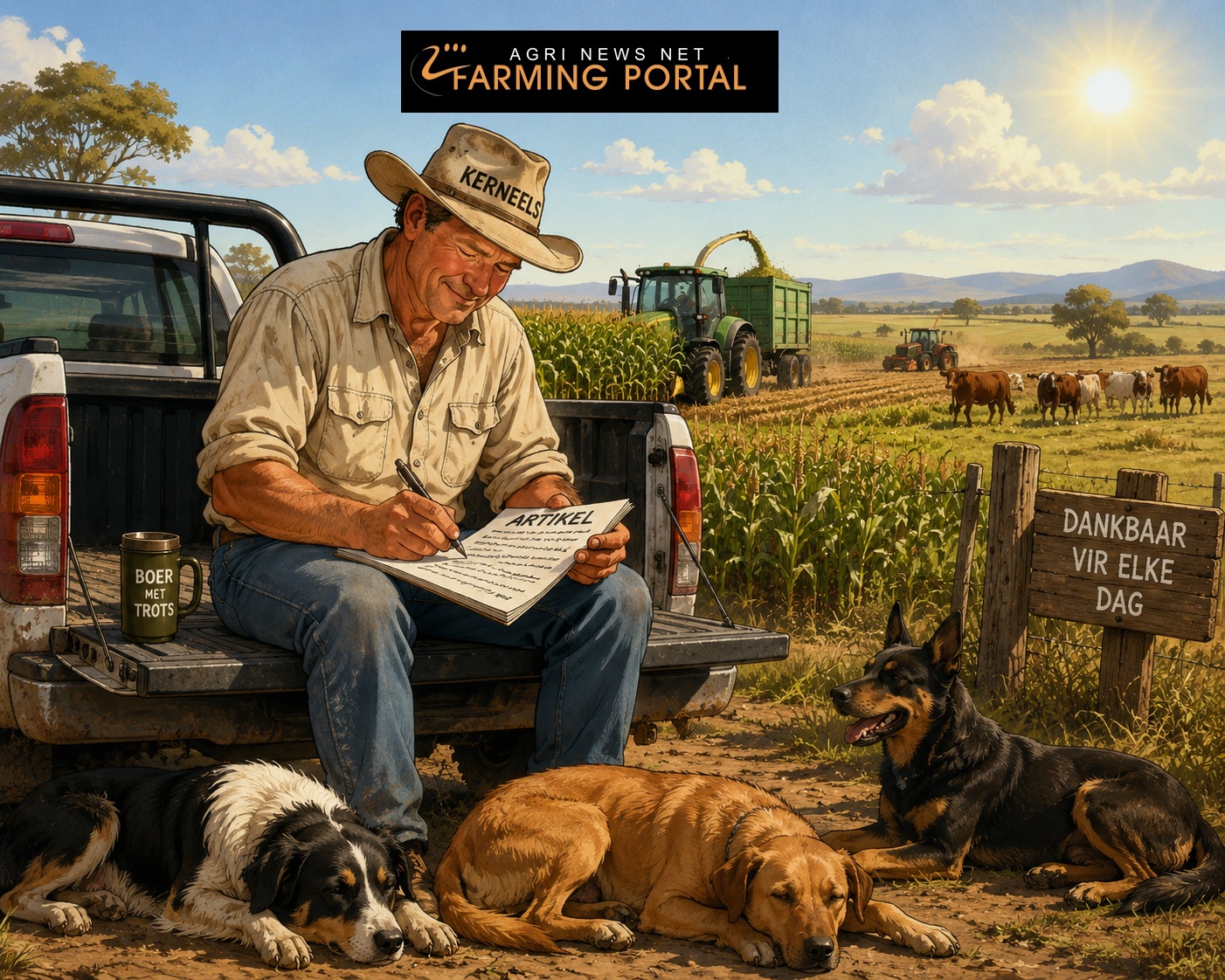
OOM KERNEELS
Van die Plaas af:
Dit was 'n rowwe week - die een oomblik is dit koud, dan warm, dan reën dit. Maar ons is besig om lande voor te berei vir die nuwe seisoen. Die ondervog lyk goed, ons moet net die somerhitte in Desember en Januarie oorleef.En daar wen die Wallabies darem die Springbokke - hulle kan bly wees daar was net 11 Wallabies oor, anders het hulle verder verloor. Dis nou wat die Walliebies se ondersteuners se.
Die URC spanne van Suid Afrika het nogal goed gedoen met hulle wedstryde oor die naweek- die WP het hulle passie verloor- Nou lees ek dat daar binnelkort 'n "bombsquad" Bier-- Klere en Kos "brand" te koop gaan wees- nou "Rugby MAL" rugby ondersteuners gaan nie genoeg plek aan hulle lyf meer he vir al die labels wat hulle moet dra nie- en nie eers praat van al die soorte bier wat hulle moet drink nie.
Ek sien die manne gesels oor die Meesterplan - daar sal baie mooi gepraat en gedink word oor hierdie plan. Ons boere is nie tevrede met die klomp voorstelle nie.Landbank het ook 'n probleem - daar is nie meer geld om uit te leen nie. Ons boere sukkel bietjie, en Landbank is nie meer Landbank soos ons dit geken nie.
Jare gelede het 'n vriend vir my gesê makadamias gaan nie lank hou nie - die Chinese is besig om duisende hektaar aan te plant. Dit lyk vir my die tyd is nou hier, ons boere sukkel bietjie.Die wit kruise wat geplant is in die VSA lok baie kommentaar in Suid-Afrika en ek sien die landbou is ook in twee daaroor.
Gertruida was by die tandarts - 'n tand wat ontsteek is, nou te uit. Die tand is sommer summier uitgetrek en die dokter is nie skaam oor sy fooie nie.
Ek was gister by Nampo Alpha -heerlike lewendehawe-skou... net so lekker gekuier tussen ou vriende. Die Vrystaat is mooi en groen.
Ek en Getruida is by 'n wildplaas hier Noord Wes vir 'n paar dae- heerlik lekker fasiliteite - skoon en netjies en die lekker om so klomp mense van jou eie bymekaar te wees. Dis families met kinders wat die water en warm weer geniet.
Ons gaan betaal vir diesel hierdie maand - en ons trekkers is nie spaarsamig op diesel nie. Ek sien darem die mieliepryse styg, maar ons het 'n hele paar tonne reeds vasgemaak op 'n prys.Nie veel nuus die week nie - maar boer lekker en geniet die week.
Groete uit die Vrystaat
Tot volgende week.
Mag julle almal ’n lekker week he ons gesels weer. OOM Kerneels.

NS -We normally do not post sponsored or external videos on our professional platforms. However, videos of this nature — which are non-marketing and informative — are not freely available YouTube channels. We will soon have our own Professional Video Channel form our own Production house.


