






With forecasts pointing towards hotter-than-normal temperatures and below-normal rainfall across much of the country, farmers need to prepare for potentially challenging production conditions ahead.
But what exactly is El Niño, and what could it mean for your farming operation?
El Niño is a naturally occurring climate phenomenon associated with changes in ocean temperatures and atmospheric circulation across the tropical Pacific Ocean. Under normal conditions, strong trade winds push warm surface water towards Southeast Asia and Australia, allowing cooler, nutrient-rich water to rise along the coast of South America. During El Niño, these trade winds weaken, allowing warmer water to move eastwards across the Pacific Ocean. This changes atmospheric circulation and influences weather patterns across the world, including rainfall and temperature patterns in southern Africa.
In South Africa, El Niño events are generally associated with below-normal summer rainfall and above-normal temperatures, although the intensity and distribution of these impacts vary between regions and seasons. The current 2026/27 El Niño event is particularly concerning because international climate forecasts indicate that it could become a very strong event. South African Weather Service (SAWS) seasonal forecasts indicate an increased likelihood of below-normal rainfall and above-normal temperatures over much of the country. This, however, does not mean that every farming area will experience drought, but it does mean that farmers should take the forecasts seriously and start managing their production risks.
What could El Niño mean for South African agriculture?
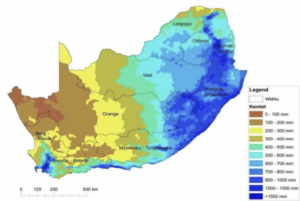
South Africa is already a relatively water-scarce country (see figure opposite), with many farming areas dependent on seasonal rainfall. Most summer-rainfall agricultural areas receive most of their annual rainfall between October and March. The timing, amount and distribution of this rainfall are critical for crop establishment, pasture growth and livestock production. When rainfall is delayed, reduced or poorly distributed, the consequences can be severe.
1. Livestock production and natural grazing
Livestock farmers could experience some of the most serious consequences of prolonged dry conditions. Natural rangelands are the foundation of livestock production in many parts of South Africa. Reduced rainfall limits grass growth which in turn reduces grazing availability and can affect the nutritional quality of available forage. This is particularly concerning in areas where livestock production depends almost entirely on natural veld. Poor grazing conditions can result in livestock losing body condition, reduced reproductive performance, lower conception rates, poor lambing and calving outcomes, and increased animal mortality. Sheep and cattle farmers may also experience reduced wool production, lower weaning weights and declining beef production. Another important concern is the delayed recovery of natural grazing following drought. Even when rainfall eventually returns, veld recovery may take time, and season change particularly where grazing pressure has been high.
2. Forage and fodder production
The production of hay, silage and other livestock feeds is also vulnerable to reduced rainfall. Farmers who depend on planted pastures and annual forage crops may experience reduced biomass production and lower-quality feed. This could increase competition for available livestock feed and result in higher feed prices.
Forage shortages may become particularly severe towards the end of the dry season when natural grazing reserves are depleted. Farmers should therefore consider securing additional feed resources before shortages become widespread. Planted pasture under irrigation can serve as vital alternative source of supplementary feed during this difficult EI Nino conditions.
 The Future of Livestock Farming in 2027 – Can Red Meat Still Be Affordable?
Is South Africa entering the El Niño season without any protection?
There is some positive news. Above-normal rainfall during the 2025/26 summer season, resulted in improved soil moisture and dam levels in many summer-rainfall areas. This provides a useful buffer as South Africa enters the 2026/27 production season. However, this should not create a false sense of security. Soil moisture reserves can decline rapidly under prolonged hot and dry conditions, while increased evaporation and crop water requirements can place additional pressure on available water resources. Farmers should also recognise that El Niño does not affect all parts of South Africa equally. Local weather systems, regional rainfall patterns and other ocean-atmosphere interactions can influence the final outcomes. The important message is that farmers should prepare for the increased risk of drought or flooding rather than assume that the entire country will experience the same conditions.
What can livestock farmers do to reduce the impact?
Although farmers cannot control the weather, they can make management decisions that reduce the impact of drought and heat stress on their farming operations. The following measures are recommended:
- Assess the condition of natural grazing and determine the carrying capacity of the farm before the veld deteriorates and reduce livestock numbers.
- Implement rotational grazing and provide adequate recovery periods for grazing camps.
- Identify alternative feed resources, including hay, silage, crop residues and suitable cultivated forage crops to build fodder bank.
- Prioritise the nutritional requirements of breeding animals, pregnant females and young livestock.
- Ensure that animals have access to sufficient clean drinking water and shade to reduce heat stress.
The role of indigenous forage resources and alternative livestock feeds
An important lesson from previous droughts is that livestock farmers need to diversify their feed resources rather than rely exclusively on natural grazing. South Africa has a wide diversity of indigenous grasses and legumes that have evolved under challenging environmental conditions. These species represent valuable genetic resources for identifying and developing forage options suited to water-limited production environments.
Research into indigenous forage species, drought-tolerant cultivated pastures and the utilisation of encroaching woody species as livestock feed could provide additional opportunities for improving feed security.
The utilisation of suitable crop residues and other locally available feed resources can also help farmers bridge seasonal feed shortages. However, alternative feed resources must be evaluated for their nutritional value, digestibility, potential toxicity and suitability for different livestock species before being incorporated into feeding programmes. Investing in improved forage production, feed conservation and alternative feed resources is therefore an important part of building more resilient livestock production systems.
What should government and agricultural institutions be doing?
The responsibility for managing the impacts of El Niño does not rest with farmers alone. Government departments, agricultural research institutions, extension services and the private sector all have an important role to play. Government should strengthen early-warning systems and ensure that climate information reaches farmers in a form that is practical and easy to understand. Extension officers should assist farmers in interpreting seasonal forecasts and translating this information into appropriate farm management decisions.
Other important interventions include:
- Providing targeted drought-relief support to vulnerable smallholder and commercial farmers.
- Developing mechanisms to assist farmers who experience significant crop establishment failures and livestock feed shortages.
- Strengthening water infrastructure, including water storage, rainwater harvesting and efficient irrigation systems.
- Supporting research into drought-tolerant crops, improved forage varieties, indigenous forage resources and sustainable rangeland management.
- Strengthening collaboration between government, agricultural research institutions, universities, farmer organisations and the private sector.
The Agricultural Research Council (ARC), through its research programmes in crop improvement, animal production, range and forage sciences, has an important role in developing technologies and management strategies that can help farmers adapt to increasingly variable climatic conditions. Research should also continue to focus on improved rangeland management, sustainable livestock feeding strategies and the identification of alternative forage resources for drought-prone areas.
The message to South African farmers: Prepare now, not when the drought arrives. We cannot control El Niño, but we can control how prepared we are for it.
The 2026/27 El Niño event presents a significant risk to South African agriculture. While the full extent of its impact remains uncertain, the current climate outlook provides sufficient reason for farmers to take precautionary action. Farmers should make informed decisions, conserve available resources, protect their natural grazing, plan their livestock feed requirements and remain alert to changing weather conditions. The most important lesson is that drought preparedness must become part of normal farm management rather than an emergency response once conditions have already deteriorated. South African agriculture has faced severe droughts before, and experience has shown that farms with good planning, sound natural resource management, diversified feed resources and effective risk-management strategies are better positioned to withstand difficult seasons.


