









-Welcome to our world- the real world of Farming and Agriculture in South Africa- Local and International news- (Farmingportal.-172,106 hits per minute) Readers per week- 16,789
 This AGRI NEWS RUSH - Just that one Step Ahead -Some of the news stories of this week-, SUNDAY EDITION - ALWAYS ON TIME - AGRI NEWS RUSH is now one of the most read Articles on a Sunday
AGRI NEWS RUSH - HEADLINE NEWS OF THE WEEK - www.agrinewsnet.co.za
The outlook for South Africa's 2026-2027 farming season starting mid-October is unusually uncertain.Input costs are under pressure from the unresolved U.S.-Iran war and supply constraints on the Strait of Hormuz.
China imported about 40,565 tonnes of shelled cashew kernels in 2024, an average of 111 tonnes per day.Vietnam remains the dominant supplier, but China's sourcing is diversifying. Côte d'Ivoire, Myanmar and Tanzania all grew their share, with Côte d'Ivoire and Tanzania together accounting for more than 20% of import volume.
The earth is warming faster than at any time in recorded history. That is not hyperbole, it is fact. Yet there is no immediate, practical way to reverse the trend short of a global shutdown on the scale of the COVID-19 pandemic, which itself would create a more dire situation.
Kenya faces a major maize shortfall in 2026-27 after drought devastated its crop, needing to import about two million tonnes of its four million tonne annual requirement.While global maize supply is ample, Kenya uses white maize for human consumption, which is not widely produced.
Chicken importers argue that recent strong profits at major producers Astral Foods and Rainbow Chicken mean South Africa no longer needs import tariffs on poultry, echoing calls from the US.FairPlay founder Francois Baird countered this in The National, saying the argument is simplistic. General or Most Favoured Nation (MFN) tariffs are separate from anti-dumping duties on nine countries
Grain SA has advised grain producers under financial pressure to speak to their financiers as early as possible.The earlier producers discuss challenges with banks, cooperatives and other financial partners, the greater the chance of finding realistic, workable solutions. This was a strong consensus from discussions with financiers at Nampo Kaap.
The global orange market is in seasonal transition, with Southern Hemisphere campaigns winding down and Northern Hemisphere origins preparing to start.South Africa dominates Europe but had a tough season. Heavy rain and wind caused peel damage, Brix was low, and port congestion left millions of cartons stranded.
South Africa's cherry industry has secured market access to China, the world's largest cherry-importing market at nearly 590,000 tonnes in 2025, just as volumes are growing.Production climbed 54% over two seasons from 3,300 tonnes in 2024/25 to a projected 5,100 tonnes in 2025/26.
In grains, the latest WASDE numbers are being watched to see if they are finally forming a floor under maize and soybean prices, while wheat tells a different story. In livestock, pressure is building on weaner calf and sheep prices, but pork and chicken may be nearing a turning point.
At a Food For Mzansi fireside chat held during Nampo Cape 2026 in Bredasdorp, Agriculture Minister Willie Aucamp and Land Bank acting CEO Jabu Mphambo discussed farm debt, structural financing challenges, biosecurity crises, and the need to reshape agricultural finance in South Africa.
The fifth wool sale of the season, which mainly featured fine-micron wools, continued the recent downward trend despite a weaker rand against the US dollar. Of the 7 141 bales on offer, 97,7% were sold, supported by strong competition for higher-quality Merino and certified lots.
Willie Aucamp, minister van landbou, het Vrydagoggend 18 September met veeboere van die Humansdorp-omgewing gepraat oor die vordering wat in die stryd teen bek-en-klouseer gemaak word. Dit was as deel van sy besoek aan die Oos-Kaap en die Gamtoosvallei wat in Mei onder erge vloede deurgeloop het.
Farmers vaccinating against foot-and-mouth disease must still maintain strict movement control and biosecurity, RMIS vet Dr. Peter Evans warns.The vaccine is not a cure and does not provide immediate protection.
Saai welcomes the strict disciplinary action taken against Jacob Madumo, CEO of Onderstepoort Biological Products (OBP), and the investigation into alleged manipulation of foot-and-mouth disease vaccine prices.
The red meat and wool producer organisations in the Western Cape focused at their joint annual meeting this year on challenges but also on new opportunities in local and international markets. Despite pressure, export markets still offer growth potential.Red meat prices in the Western Cape remained strong in 2026, described as a challenging but resilient year.
As South Africa celebrates heritage this September, Rooibos is showing how a proudly South African product can stay true to its roots while finding new audiences globally.Rooibos now reaches more than 50 international markets, with Japan the largest destination accounting for 33% of exports in 2025.
Growth in global animal protein production is expected to continue slowing in 2026 due to cyclical and structural factors. Seafood will remain the leading contributor to growth, followed by poultry, while pork and beef are expected to contract, marking the first reduction in global terrestrial species output in six years.
South Africa’s ambassador to the United States was appointed with the task of repairing ties with its key Western economic partner and boosting trade and investment. Instead, Pretoria failed to support meaningful progress, and Washington has now imposed sanctions.
If you are using our content in your media coverage or on any agricultural radio programme, we would greatly appreciate it if you could credit the source. We understand how valuable and convenient this information can be—especially on a Monday morning after a weekend of NO WORK .

|
Category
|
Price (R/kg)
|
Notes
|
|---|---|---|
|
Class A2/A3 carcass
|
R63.90 – R67.20
|
Recent AMT/Absa range; firm due to FMD-related supply constraints
|
|
Class C carcass
|
R55.90 – R58.60
|
Cull/cow market
|
|
Weaner calves (200–250 kg)
|
R46.90 – R50.00
|
Live weight; supported by demand and limited supply
|
|
Category
|
Price (R/kg)
|
Notes
|
|---|---|---|
|
Class A lamb carcass
|
R90 – R108+
|
Strong year-on-year gains; Absa forecasts ~R90.80/kg average for 2026
|
|
Class C / mutton
|
R60 – R78
|
Supported by tight global and local supplies
|
|
Category
|
Price (R/kg)
|
Notes
|
|---|---|---|
|
Porker
|
≈ R28.50 – R33
|
Producer/abattoir level
|
|
Baconer
|
≈ R28.60 – R34.50
|
Disease (ASF + FMD) disruptions providing support
|
|
Category
|
Price (R/kg)
|
Notes
|
|---|---|---|
|
Fresh whole bird
|
≈ R35 – R41
|
Absa forecast ~R41/kg average for 2026
|
|
Frozen whole bird
|
≈ R32 – R35
|
|
|
IQF portions
|
≈ R31 – R37
|
- FMD continues to constrain cattle and sheep supply chains and support red-meat prices.
- ASF and FMD are supporting pork prices through supply disruptions.
- Poultry prices remain relatively firm but face competition from other proteins.
- Retail prices (August 2026 averages): Beef ≈ R159/kg, Lamb ≈ R187/kg, Pork ≈ R122/kg, Chicken ≈ R70/kg.

|
Commodity
|
Price (R/tonne)
|
Daily Change
|
|---|---|---|
|
White Maize
|
R3 928
|
−R3
|
|
Yellow Maize
|
R3 938
|
−R27
|
|
Wheat
|
R6 029
|
−R41
|
|
Sunflower Seed
|
R9 960
|
−R80
|
|
Soybeans
|
R8 860
|
−R93
|
- 17 Sep: White maize R3 931 (−68), Yellow maize R3 965 (−50), Wheat R6 070 (−35), Sunflower R10 040 (+10), Soya R8 953 (−39)
- 16 Sep: White maize R3 999, Yellow maize R4 015, Wheat R6 105, Sunflower R10 030, Soya R8 992
- Prices have generally softened over the past week, with maize trading in the R3 900–R4 000 range and oilseeds under pressure.
-
- Farmers and state clash over response to FMD
- Farmers call for independent FMD test result verification
- SA’s agribusiness confidence returns to positive territory (Agbiz/IDC index rises to 53)
- El Niño looms but South Africa’s farmers are better prepared for drought
- South Africa harvesting largest corn crop on record (estimated 18 million metric tons)
- SA agricultural exports surge 11% in first half of 2026
- Calls for urgent reform as Western Cape agriculture faces mounting risks
- Farmers urged to chase profit, not tons
- Technology and scale, not land alone, will shape farming’s future
- How tech is shaping the future of animal feed
- High praise for Die Krip Landboufees
- Wheat industry ‘heading for tragedy’ without urgent reform
- SA dairy sector must learn to live with FMD
- Pig industry turns crisis into a test of stewardship
- Voluntary FMD vaccination poses major threat to red meat sector
- Facts and collaboration crucial as farm risks converge
- Agriculture announces Egypt opening its market to South African red meat
- AgriSETA targets agricultural skills to tackle youth unemployment and food insecurity
- Western Cape must accelerate climate adaptation and port reforms
- Flood recovery continues in Western Cape agriculture (R9 billion total damage assessed)
- National average dam levels at 95.5% – better drought resilience than 2016
- Disease drives SA pork and poultry prices higher
- FMD rewrites the rules for SA red meat
- New FMD framework offers farmers a clearer path to recovery
- Antimicrobial resistance poses a risk to animals and humans
- How smarter breeding is reshaping tomorrow’s crops
- SACTA reinforces the importance of seed research
- Wool and red meat producers urged to move closer to their markets
- Technology and resilience in focus at Nampo Cape 2026
- Profitability, security and self-reliance in spotlight at TLU SA Congress
- SA to boost local FMD vaccine production capacity
- Nearly 23 million FMD vaccine doses imported
- Almost entire dairy herd vaccinated at least once this year
- Grain and feed update: Corn sector expected to remain stable
- Wheat plantings at lowest levels in nearly a century
- Disruptive rain warnings issued for KwaZulu-Natal and Eastern Cape (18 September)
- Rising diesel prices add pressure ahead of summer planting season
- Agriculture could help save SA from a recession (bumper harvests expected)
- Farming confidence is back, but El Niño threatens the rebound
- Port inefficiencies continue to hit agricultural exports
- Call for climate-smart agriculture ahead of expected El Niño
- AI moves from experimentation to execution in SA farming
- Traceability becoming essential for red meat and wool markets
- Animal disease, weather and geopolitics converge as key farm risks
- Strong horticulture and field crop harvests support market share gains
- Capital investment sub-index shows mixed signals amid caution
- Export volumes sub-index rises on stronger agricultural shipments
- Biosecurity remains central challenge for pork and cattle sectors
- Western Cape FMD vaccination coverage reaches high levels
- Ongoing need to open new export markets for long-term growth
These reflect the dominant themes in current coverage: ongoing FMD management and testing debates, improving agribusiness confidence, strong grain/export performance tempered by El Niño risks, Western Cape-specific challenges (ports, floods, climate), and calls for greater efficiency, technology and policy reform.

READ MORE ( Stats) Listen to all our Daily Audiocast - It is doing very good. But also see that some news mediums like to follow us.
MORE GOOD NEWS - AUDIO AGRI NEWS NET which was selected by Million Podcasts as one of the Top 100 Agriculture Podcasts, Top 100 Farming Podcasts and Top 100 Sustainable
Agriculture Podcasts on the web. READ MORE
- Vaal Dam: Held steady near full capacity during the week of 14–18 September, fluctuating between 99.75% and 99.49% (weekly average ≈99.57%). This is lower than the same time last year (around 105.5%) but remains very healthy.
- Gariep and Vanderkloof Dams (Orange River system): Continue to operate near or at full capacity (recent figures around 99–100%).
- Western Cape / Cape Town System: The main area of concern. Combined system dams were reported in the mid-to-high 70% range (around 74.7–77.7% in mid-September figures). Theewaterskloof hovered near 76%. Year-on-year this represents a notable drop, prompting the City of Cape Town to consider water restrictions in coordination with other municipalities and the Department of Water and Sanitation.
- Free State and North West: Extremely strong, often at or above 100%.
- Mpumalanga: Around 98–99%, though some Lowveld dams recorded small weekly declines, prompting calls for intensified water conservation.
- KwaZulu-Natal: Around 85–87%, lower than the previous year.
- Eastern Cape: Around 90–92%.
- Western Cape: Lowest major region at approximately 75–80%.


- Urea (46%): Averaged around R17 500–R21 000/t in mid-year readings, with some monthly declines after earlier spikes. Still substantially higher year-on-year (up to ~40–90% in some periods).
- LAN (28%): Around R19 000/t, showing relative stability or modest declines in some months.
- MAP: Remained under upward pressure (around R22 000–R23 000/t), supported by higher sulphur and ammonia costs and tighter global phosphate supplies.
- Potassium chloride (MOP/KCl): Declined in some months (around R10 800–R13 000/t range) but still higher than the previous year in many comparisons.
- Seed demand is linked to the upcoming summer planting season (maize, soybeans, sunflower) and the recently completed or ongoing winter grain (wheat/canola) cycle.
- Maize seed remains the largest volume category. Improved genetics and precision agriculture continue to support yield potential, helping offset some cost pressures.
- Wheat plantings in 2026 were reported at historically low levels (around 474 000 ha), reflecting tight margins and high input costs (including seed, fertiliser and diesel).
- Soybean and sunflower seed demand is supported by relatively firm oilseed markets earlier in the year, though recent SAFEX prices for the commodities themselves have softened.
- Farmers are advised to order seed early and match varieties to specific production zones, especially given expected El Niño risks for the 2026/27 summer season.

DISCLAIMER
The views and opinions expressed in this program are those of the writers and do not necessarily reflect the views or positions of any entities they represent. The information contained in this website is for general information purposes only. The information is provided by CRA and while we endeavour to keep the information up to date and correct, we make no representations or warranties of any kind, express or implied, about the completeness, accuracy, reliability, suitability or availability with respect to the website or the information, products, services, or related graphics contained on the website for any purpose. Any reliance you place on such information is therefore strictly at your own risk.Just for your information. - We need to share this as this is part of Farming and Agriculture.
AGRI NEWS NET stands as South Africa’s leading source for farming and agriculture news, delivering trusted, up-to-date content 7 days a week, 365 days a year. With over 50 “good news stories you can trust,” the platform is driven by 30 years of practical farming and media experience, ensuring a deep understanding of the needs and realities of farmers and the agricultural sector. AGRI NEWS NET prides itself on being committed, independent, focused, and always on time. As part of the CRA Group, the platform leverages its extensive expertise to provide reliable, farmer-centric news. Its content is compiled using advanced AI technology, ensuring accuracy and relevance while staying connected to the broader global farming and agriculture community. For the third consecutive year, AGRI NEWS NET’s Daily Audiocast has been ranked among the top 15 agricultural podcasts on Feedspot, a testament to its quality and impact. The audiocast delivers concise, engaging updates, making it a go-to resource for farmers, industry professionals, and agriculture enthusiasts seeking timely insights. With a focus on “good news stories,” AGRI NEWS NET highlights positive developments, innovations, and successes in South African agriculture. Rooted in real-world farming knowledge and media expertise, AGRI NEWS NET bridges the gap between farmers, policymakers, and the public. Its AI-driven platform ensures comprehensive coverage, from local issues . By focusing on practical, trustworthy content, AGRI NEWS NET empowers the agricultural community to stay informed and inspired.

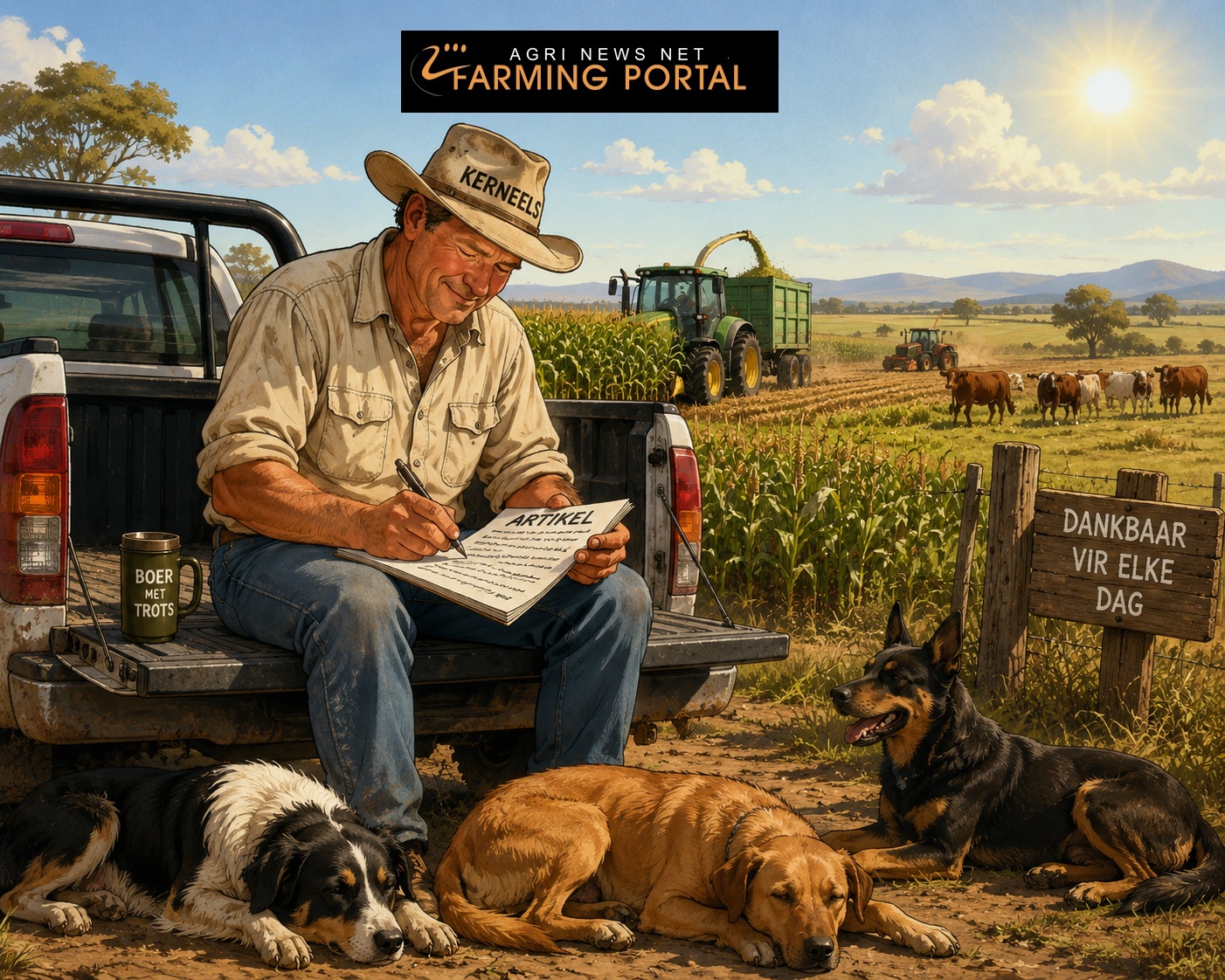
OOM KERNEELS
Van die Plaas af:
Ek het gister so bietjie vis gaan vang hier in die Vaalrivier, maar ek het nie baie lank gesit nie. Die water is nie van die skoonste nie. Vuil, troebel, jy kan skaars jou dobber sien. En om te dink die rivier was lank ons speelplek gewees - met motorbote, kinders wat swem, braaivleis op die oewer. Daardie dae toe die regering nog besorg was oor ons land en sy infrastruktuur en water.
Getruia wou nie eers saamkom nie. Sy het die week 'n heerlike tert aanmekaar geslaan en ek sien sy besig met haar vrugtekoeke vir Kersfees - my brandewyn gaan weer vrylik gebruik word.
Intussen is dinge aan die gebeur in die buiteland. Trump is nou ernstig oor sy verhouding met Suid-Afrika se sogenaamde leiers wat nie wil doen wat hy sê nie. Die manne is baie omgekrap maar dis nou soos ons hulle ken.
En die hele wêreld is deurmekaar met sy oorlog daar in Iran en dit lyk my ons gaan baie, baie duur betaal vir petrol en diesel. Hy kry nie die oorloë tot 'n einde nie.
Hier lyk dit my die ou garde ANC-leiers het almal 'n siekte onder lede. Ek dink hulle drink en eet te veel en doen te min. Die edele President is ook afgeboek.
Maar wat my nou regtig omkrap, en ons oë moet wakker word hieroor, is ons landbou unies. Ek sien 'n lelike ding wat sy kop al lankal uitsteek met hierdie privaat organisasies wat opstaan en bestuur word deur korporatiewe amptenare en eienaars wat geld van oral ontvang en met baie beloftes dalk niks daarmee gaan doen nie.
Daar is nog steeds groot verdeeldheid onder die boere, maar ons jonger geslag boere moet begin aansluit by hulle eie organisasies wat vir hulle baklei en moenie toelaat dat die amptenare die besluite neem nie. Ons moet self ons stem dik maak, anders praat iemand anders namens ons .
En ja, die rugby is vir eers nou op ys. Ons sal maar volgende week sien wat die Wallabies in die mou voer. Ek probeer so nou en dan televisie kyk, maar dis nie meer 'n plesier nie - die argaanse advertensies en swak aanbieders wat jou irriteer laat my sommer gou-gou uitstap.
Getruia sê ek moet liewer buite gaan sit- sy geniet dit- Dit het lekker gereen die week op verskeie plekke en ons moet maar dalk ander dink oor die seisoen.
Groete uit die Vrystaat
Tot volgende week.
Mag julle almal ’n lekker week he ons gesels weer. OOM Kerneels.

NS -We normally do not post sponsored or external videos on our professional platforms. However, videos of this nature — which are non-marketing and informative — are not freely available YouTube channels. We will soon have our own Professional Video Channel form our own Production house.


