









Welcome to our world- the real world of Farming and Agriculture in South Africa- Local and International news- (Farmingportal.-178,106 hits per minute) Readers per week- 20,589
 This AGRI NEWS RUSH - Just that one Step Ahead -Some of the news stories of this week-, SUNDAY EDITION - ALWAYS ON TIME -
AGRI NEWS RUSH is now one of the most read Articles on a Sunday
AGRI NEWS RUSH - SOME HEADLINE NEWS OF THE WEEK - www.agrinewsnet.co.za
Published 30–50 stories daily, focused on South African and Southern African farming, commodities, policy, weather, and related topics.
50 recent headline stories from Agri News Net the week of 15th November 2026
- Official climate plan estimates R3.47 trillion needed for mitigation and R250 billion for adaptation (2026–2035).
- Africa missing major opportunity by exporting raw coconuts instead of local processing/manufacturing.
- South Africa launches R2 billion programme to support land-reform beneficiaries with viable agri businesses.
- Botswana Nation Address focuses on water, roads, and food security for Pandamatenga farmers.
- Latest 2026 crop estimate: Free State wheat harvest better than initially expected (~300,800 tons).
- Willem Groothof named Farmer of the Year 2026 by Landbouskrywers SA.
- High Court ruling: Landowners must be consulted on water extraction impacting agricultural users.
- SA exporters warn new markets insufficient without competitive trade deals amid potential AGOA end (2027).
- Precision farming gains traction in East and Southern Africa via connectivity and local expertise.
- Gauteng strengthens trade/investment ties with Europe in renewables, minerals, and climate tech.
- Wildlife corridors essential as animals ignore borders in Southern Africa.
- Unsafe food practices claim ~420,000 lives annually worldwide (WHO data highlighted).
- SA–China cooperation on digital economy, AI, and energy; plans for AI talent/innovation centre.
- Zimbabwe proposes levy on underutilised large-scale farms (US$50/ha escalating).
- For grain farmers, lost planting days carry high costs beyond the planter.
- Uncertainty over SA’s continued AGOA participation affects jobs and costs.
- Researcher challenges moral certainty around trophy hunting with data.
- Rising fuel/fertiliser prices + expected El Niño threaten 2027 harvests and farm incomes.
- Anonymous tip prevents Karan Beef from receiving potentially illegal Botswana weaner calves.
- Strong progress in SA citrus, berries, grapes, nuts, grains, and oilseeds (soybeans ~3 million tonnes).
- New Holland wins Sustainable Tractor of the Year 2027 with T7.270 Methane Power.
- Platform for Agricultural Carbon in Africa announced at COP31.
- Wheat yields in Swartland more than a third lower due to dry July–August (fourth tough year).
- Brazil announces Newcastle disease outbreak in chickens; SA confirms no nationwide import ban.
- Agriculture’s broader value (food, carbon, data) often invisible and unverified.
- RC Malherbe named 2026 National Cattle Farmer of the Year; Abré Marais National Sheep Farmer.
- CBOT maize futures under pressure from stronger US dollar.
- Tough citrus season compared to a “biblical plague”; significant fruit discarded.
- Springbok most expensive SA city for groceries (Oct 2026 basket); Pietermaritzburg cheapest.
- Woolworths Food division shows weak like-for-like sales growth.
- Weaner calf prices start declining but remain historically high amid El Niño concerns.
- Good rains reported in parts of Namibia.
- Lactalis SA cuts producer milk price by 70 cents/litre from 1 November.
- Draft Animal Identification Regulations gazetted for public comment (criticised for red tape).
- Freedom Front Plus calls for scrapping BEE requirements on preferential food import permits.
- Minister Maynier agrees to restart stalled Forestry Master Plan meetings.
- Cassava remains highly undervalued in Africa despite Nigeria’s large production.
- Proposed animal ID regulations risk extra costs and admin burdens for livestock producers.
- Dairy farmers remain at the bottom of the value chain despite creating the product.
- Further diesel price relief possible in December as oil prices fall.
- 2026 set to be among the four warmest years on record; El Niño risks into 2027.
- Southern African citrus exports: 201 million cartons in 2026 (tough, unprofitable season).
- Climate finance often arrives too late for timely agricultural action (COP31 context).
- Botswana beef offtake far below target after FMD outbreaks disrupt production/exports.
- EIMA International 2026 opens amid declining tractor sales in major markets.
- Grain and oilseed producers form the start of the household food chain.
- Namibia warns livestock producers against moving animals in breach of quarantine rules (FMD).
- Two communal livestock owners and a shepherd murdered in Free State; linked to stock theft.
- Record summer grain harvests (21.7 million tons) have not restored SA farmer profitability (earlier context still circulating).
- Foot-and-Mouth Disease responses, vaccine procurement, and regional impacts continue as ongoing major stories (Namibia crisis noted; SA measures referenced across feeds).
- South Africa has vaccinated 90% of its national cattle herd against Foot and mouth disease (FMD), surpassing the initial target of vaccinating 80% of the national herd by December 2026.
If you are using our content in your media coverage or on any agricultural radio programme, we would greatly appreciate it if you could credit the source. We understand how valuable and convenient this information can be—especially on a Monday morning after a weekend of NO WORK .


South African Grain and Oilseed Prices – around 13 November 2026
Prices are SAFEX/JSE futures settlement or last-traded levels in rand per tonne (R/t), excluding VAT and location differentials. These are the main reference prices used for local grain and oilseed trading.
Key settlement / reference prices
Thursday 12 November 2026 (Dec 2026 main contracts – official settlements)
- White maize: R4,073/t (+R150)
- Yellow maize: R3,912/t (+R150)
- Wheat: R5,878/t (+R9)
- Sunflower seed: R10,062/t (+R235)
- Soybeans: R9,108/t (+R24)
Friday 13 November 2026 (trading / last traded / reference levels)
From Grain SA feeds and market reports (intraday/last traded around mid-morning to close references):
- White maize (WMAZ): Nov ~R4,020–4,040; Dec ~R4,051–4,079
- Yellow maize (YMAZ): Nov ~R3,880; Dec ~R3,901–3,921
- Wheat (WEAT): Dec ~R5,855
- Sunflower (SUNS): Nov ~R10,034; Dec ~R9,950–9,991 (softer after the prior day’s rally)
- Soybeans (SOYB): Nov ~R9,155; Dec ~R9,190
Spot/reference summaries for 13 Nov also listed white maize around R4,040/t and yellow maize around R3,880/t, with soybeans near R9,150/t.Theoriginalgraincompany
Recent context
- Maize prices strengthened sharply on 12 November after softer levels earlier in the week/month. A large 2026 maize crop has kept prices near export parity overall.
- Sunflower saw a strong rebound on 12 Nov before some pullback on 13 Nov.
- Soybeans have been firmer in recent sessions.
- Wheat remains relatively stable in the mid-to-high R5,800s for nearby contracts.
 AGRI NEWS NET- WEEKEND NEWS RUSH Summary of the Week 8 November 2026
- SA set for record canola harvest of 368 270 tonnes
- Record maize crop of 17.7 million tonnes cushions El Niño fears
- Farmers slash maize plantings by 12% as strong El Niño looms
- Sunflower plantings surge nearly 45% amid drought concerns
- Grain SA seeks new court date after soya bean interdict struck off roll
- AgriSA backs Grain SA in fight over JSE soya bean pricing
- Weaner calf prices continue to ease as more animals enter market
- RPO warns farmers against false rumours of Namibia and Botswana calf imports
- Namibia and Botswana borders remain closed for livestock and meat
- Lactalis cuts producer milk price, adding pressure on dairy farmers
- Agricultural employment drops 34 000 jobs in third quarter
- Government advances release of 2.5 million hectares with title deeds
- President Ramaphosa pushes agricultural transformation and land access
- Limpopo hands over hemp seeds and fertiliser to 12 permit holders
- RMIS focuses new levy cycle on biosecurity and traceability
- Table grape industry forecasts 78.4 million cartons for 2026/27 season
- Ample maize stocks expected to keep food inflation in check
- Farmers switch to drought-tolerant crops as El Niño intensifies
- High diesel and fertiliser costs squeeze summer crop budgets
- Canola success story offers blueprint for other SA crops
- Feedlots feel pressure from elevated weaner prices earlier in season
- Strong slaughter cattle prices bring some relief to feedlots
- ARC study suggests shifting some crops to cooler regions could pay off
- SA remains net canola exporter with growing shipments to Europe
- Wheat harvest stays low, increasing reliance on imports
- Early planting continues in many areas despite dry outlook
- Meat prices may ease as large maize harvest lowers feed costs
- Red meat industry prepares for new four-year statutory levy cycle
- Port inefficiencies and tariffs continue to challenge fruit exporters
- Soil moisture still favourable in key grain-producing regions
- Free State, North West, Mpumalanga and Limpopo most at risk from El Niño
- Soya bean production tops 3.1 million tonnes in 2025/26 season
- Farmers plan smallest maize area in eight years
- White maize plantings expected to drop more than 18%
- Record summer grain and oilseed harvest supports food security
- Dairy producers face dual pressure of lower prices and higher input costs
- Government explores drought preparedness measures for 2026/27 season
- Horticulture continues to drive SA agricultural export growth
- Title deeds seen as key to unlocking black commercial farming potential
- Live cattle and sheep export opportunities remain constrained by disease
- Western Cape canola crop performs well despite mixed weather
- Grain SA estimates R800 million exposure from disputed soya pricing
- Consumers benefit as food inflation hits 16-year low
- Producers prepare for tighter margins in 2026/27 planting season
- Biosecurity remains top priority for red meat value chain
- Early sunflower planting under way in western production areas
- Agricultural exports show resilience despite global headwinds
- Dam levels offer temporary buffer but rain-fed crops still vulnerable
- Collaboration between commodity groups and government urged on land release
- Industry calls for continued investment in productivity and market access
- www.agricultureportal.co.za

READ MORE ( Stats) Listen to all our Daily Audiocast - It is doing very good. But also see that some news mediums like to follow us.
MORE GOOD NEWS - AUDIO AGRI NEWS NET which was selected by Million Podcasts as one of the Top 100 Agriculture Podcasts, Top 100 Farming Podcasts and Top 100 Sustainable
Agriculture Podcasts on the web. READ MORE
Latest on the 2026/27 El Niño (as of mid-November 2026)
The ongoing El Niño is very strong and continues to intensify. It is one of the strongest events on record and has a significant chance of becoming the strongest since at least 1950.Cpc.ncep.noaa
Current Status (NOAA CPC, 12 November 2026)
- El Niño Advisory remains in effect: “El Niño conditions are present and strengthening.”
- Weekly Niño 3.4 sea-surface temperature (SST) anomaly: approximately +3.3°C (week centred 4 November 2026) — well into the “very strong” range.
- Other indices: Niño-3 around +3.6°C to +4.4°C; Niño-1+2 even higher (up to ~+5.6°C in some readings); subsurface temperatures remain significantly elevated.
- Japan Meteorological Agency (JMA) noted NINO.3 SST deviation of +4.4°C in October 2026 — a record high since records began in 1949.
Outlook
- Expected to continue strengthening before beginning to weaken in early 2027.
- Strong-to-very strong El Niño is likely through January–March 2027 (>79% chance).
- Probability of a historic/record event (3-month Relative Oceanic Niño Index / RONI of +2.5°C or higher, exceeding previous events since 1950): about 60% for October–December 2026 and November–January 2026/27 (down from higher odds earlier).
- Virtually certain (near 100%) to persist through boreal spring 2027 (into March–May), then probabilities decline later in 2027.
Impacts for Southern Africa / South Africa
El Niño typically favours below-normal rainfall and above-normal temperatures across much of Southern Africa during the summer rainy season.
- South African Weather Service (SAWS) and regional outlooks point to increased chances of drier and hotter conditions for October–December 2026 and into early 2027.
- Concerns focus on agriculture (crop planting, yields, livestock), water resources, and food security — especially in areas historically sensitive to strong El Niño events (e.g., parts of the Free State, North West, and neighbouring countries).
- Dam levels in South Africa are currently relatively favourable compared with the severe 2015/16 drought, providing some buffer, but infrastructure challenges and rising temperatures remain risks.
- FEWS NET and others flag elevated drought risk across Southern Africa for the October 2026–March 2027 season.
Global context: The event is contributing to elevated global temperatures and extreme weather risks (heat, drought in some regions, heavy rain/flooding in others). The World Meteorological Organization has described recent climate extremes as “off the charts.”
Sources: NOAA Climate Prediction Center (latest diagnostic discussion 12 Nov 2026), JMA, SAWS seasonal outlooks, WMO, and regional analyses. Conditions and forecasts are updated regularly — check official sources such as NOAA CPC or SAWS for the most current updates.

South African Dam Levels Report – around 14 November 2026
Data is drawn from the Department of Water and Sanitation (DWS) weekly reports and related provincial/municipal updates covering the period ending roughly 9–12 November 2026. Levels are generally still high nationally heading into summer, but most systems show slight weekly declines amid rising temperatures and the developing strong El Niño.
Provincial averages (approx. week ending 10–11 November 2026)
Lesotho: ~91.2% · Eswatini: ~96.7%
Key systems and major dams
Integrated Vaal River System (IVRS) — supplies Gauteng and surrounds: 97.4% (down from 97.8% the previous week). Remains well supplied.
- Vaal Dam: 104.3% (still above full supply capacity)
- Grootdraai Dam: 99.0%
- Bloemhof Dam: 92.2%
- Sterkfontein Dam: 98.8% (stable)
Free State (average 98.7%, down from 99.7%): Most major dams still above 90%.
- Gariep Dam: ~98%
- Vanderkloof Dam: ~98.7%
- Other notable: Rustfontein ~94.4%, Bloemhof 92.2%, Sterkfontein 98.8%.
Western Cape / Cape Town system: Provincial ~77.7%; Cape Town major dams combined around 71.3% (as of 12 November).
- Theewaterskloof: ~70.8–71%
- Steenbras Upper: ~100%
- Steenbras Lower: ~44.8–46%
- Berg River: ~94%
- Voëlvlei: ~52–53%
- Wemmershoek: ~76%
Authorities have advised precautionary Level 1 water restrictions in the Western Cape due to the approaching dry season and El Niño risks.
Mpumalanga (Lowveld): Provincial average stable around 96.8%. Mixed movements, with most dams showing small declines; DWS continues to urge water conservation.
Context
- Overall storage remains relatively healthy compared with previous drought years, providing a buffer as the strong 2026/27 El Niño develops.
- Slight declines are typical at the start of the dry/summer season due to higher evaporation and demand.
- DWS repeatedly urges wise water use by communities, industry, and agriculture.
Note: Exact national average is not always published weekly in summaries; provincial and system figures above are the most recent available. For the absolute latest official data, check the DWS website or weekly State of Reservoirs reports. Levels can change with rainfall and releases.

Latest Foot-and-Mouth Disease (FMD) Status Report – South Africa, Botswana & Namibia (mid-November 2026)
South Africa
South Africa continues to experience its worst FMD epidemic in recent history. The disease was declared a national disaster earlier in 2026, leading to widespread export bans and significant losses for the livestock industry.
- Official case statistics have been criticised for under-reporting, but available figures show a massive surge (tens of thousands of cases in 2025–2026 compared with under 100 annually in earlier years).
- A major nationwide vaccination campaign is underway. More than 14 million cattle (over 90% of the national herd) have been vaccinated this year. Authorities estimate ongoing annual needs of around 15 million doses.
- Progress is reported in some provinces (e.g., Gauteng has lifted many quarantine restrictions, though dozens of outbreaks remain active). Vaccination and movement controls are helping the epidemic recede in places, but it has not been eliminated.
- New concern: Cases are increasing in wildlife (including buffalo, roan antelope, sable, and kudu), raising risks for both the livestock and game industries.
- Funding challenges persist for sustained vaccination. National Treasury has allocated limited additional resources.
Status: Widespread and ongoing; vaccination and biosecurity measures are the main control tools. Export markets remain heavily restricted.
Namibia
Namibia is dealing with two separate outbreaks (the first in its former FMD-free zone in over 60 years):
- //Kharas Region (south, export zone) — Confirmed 23 September 2026. As of early–mid November: 18 infected farms, 131 positive cases. Outbreak remains confined to the Karasburg State Veterinary District. First round of compulsory vaccination completed (thousands of cattle vaccinated); second round planned. Extensive roadblocks and surveillance in place.
- Zambezi Region (north) — Confirmed 6 October 2026 on Kalala Island. First-round vaccination completed (~53,900–54,000 cattle). No new cases reported outside the designated Disease Management Area. Second vaccination round in preparation.
Economic impact: Severe. Industry estimates losses of ~N$150 million per week. Tens of thousands of jobs at risk. Export markets (including to South Africa, EU, China, etc.) suspended. Some limited market access regained (e.g., Mauritius). Meat consignments have been stuck in transit. Authorities hope to ease some restrictions before the festive season if no further spread occurs, and are working toward a containment zone and eventual restoration of free status (process expected to take up to two years).
Botswana
Botswana has made significant progress in some areas while still managing residual and border-related risks:
- Outbreaks in Zones 3c-Maitengwe and 6b (North East District) have been formally closed by the World Organisation for Animal Health (WOAH) following successful mass vaccination.
- The country is compiling a dossier to seek FMD Free-with-Vaccination status to help reopen markets.
- Active transmission continues in southern zones (especially Zones 11 and 13) near the South Africa border (areas around Phitshane-Molopo, Tshidilamolomo, and certain ranches). A containment zone is being established.
- Strong biosecurity and vaccination remain priorities. Movement restrictions have been adjusted in some zones.
Regional Summary (mid-November 2026)
Common themes: Vaccination campaigns, strict movement controls, and biosecurity are the primary tools across the region. Cross-border risks (especially SA–Botswana and SA–Namibia) remain a concern. Economic pressure on the red-meat and livestock sectors is high in all three countries.
Sources include official veterinary statements, government media releases, and recent industry reports (up to ~11–13 November 2026). Situation remains fluid — check national veterinary services (DALRRD in SA, DVS in Namibia, Ministry of Lands and Agriculture in Botswana) or WOAH for the most current official updates.

Latest Fruit Export News, Prices & Quality – South Africa (as of 14 November 2026)
Citrus (2026 Season Final Results)
The Citrus Growers’ Association of Southern Africa (CGA) released final 2026 season figures this week. South African growers packed 201 million 15 kg cartons for export — slightly below the 2025 record of ~203–204 million cartons and 4% short of the original April estimate of 209.4 million.Dailymaverick
Breakdown by variety (approx.):
- Lemons: 51 million cartons (+23% year-on-year) — the only major category to grow strongly.
- Mandarins: 50.7 million (down ~5%).
- Valencia oranges: 58.8 million (down ~5%).
- Navel oranges: 25.2 million (down ~20%, hardest hit).
- Grapefruit: ~15.4 million (stable to slightly lower).
Key challenges that made it an “unprofitable season”:
- Geopolitical disruption from the Iran war limited access to Middle Eastern markets (normally ~20% of exports), caused container shortages, port congestion, and forced longer shipping routes to Iraq and Saudi Arabia.
- Heavy rains/flooding in parts of the Western and Eastern Cape affected quality and yields of early/mid-season fruit (especially navels).
- High input costs (especially diesel), logistical issues at ports, and a relatively stronger rand.
- Stricter packing standards applied due to size mismatches (large fruit vs market preference for smaller sizes).
Despite excellent yields on many farms, overall profitability suffered. Domestic citrus prices have risen sharply in recent weeks (oranges and naartjies more than doubled in some reports). Longer-term fundamentals remain positive for Northern Hemisphere summer supply.
Avocados
South Africa exported 21 million cartons in 2026 — up 16% on the previous year thanks to good growing conditions. However, higher freight costs, a stronger rand, and strong competition from Peru (and earlier arrivals from Brazil, Kenya, etc.) kept grower returns largely flat.
Table Grapes & Deciduous Fruit
- The 2026/27 table grape season is underway with early volume increases. Recent weekly data showed a sharp rise in supply leading to a temporary price drop.
- Outlook for apples, pears, and table grapes remains relatively positive for the new season despite AGOA-related risks for the US market. Exports to Asia (especially China for apples) are expanding. Forecasts point to modest volume growth.
Recent Local Market Prices (approx. week of 10–11 November 2026)
From national fresh produce market overviews:
- Table grapes: ~R76.69/kg (down ~28% week-on-week on higher volumes)
- Avocados: ~R20.54/kg (up ~4%; Fuerte higher at ~R27, Hass ~R18)
- Lemons: ~R5.48/kg (up strongly ~25%)
- Oranges: ~R4.23/kg (up ~20%)
- Grapefruit: ~R5.97/kg (under pressure)
- Apples: ~R10.90/kg
- Pears: ~R11.03/kg
Quality notes: Citrus quality was mixed — some weather-related issues on early fruit, but overall export-grade standards were maintained through selective packing. Avocado and early grape quality appears good under favourable earlier conditions.
Outlook: Citrus season is essentially complete. Focus now shifts to the new deciduous and table grape season, with ongoing concerns around logistics, fuel costs, currency, and trade access (including post-AGOA effects). Industry bodies emphasise the need for improved resilience in shipping and market diversification.

DISCLAIMER
The views and opinions expressed in this program are those of the writers and do not necessarily reflect the views or positions of any entities they represent. The information contained in this website is for general information purposes only. The information is provided by CRA and while we endeavour to keep the information up to date and correct, we make no representations or warranties of any kind, express or implied, about the completeness, accuracy, reliability, suitability or availability with respect to the website or the information, products, services, or related graphics contained on the website for any purpose. Any reliance you place on such information is therefore strictly at your own risk.Just for your information. - We need to share this as this is part of Farming and Agriculture.
AGRI NEWS NET stands as South Africa’s leading source for farming and agriculture news, delivering trusted, up-to-date content 7 days a week, 365 days a year. With over 50 “good news stories you can trust,” the platform is driven by 30 years of practical farming and media experience, ensuring a deep understanding of the needs and realities of farmers and the agricultural sector. AGRI NEWS NET prides itself on being committed, independent, focused, and always on time. As part of the CRA Group, the platform leverages its extensive expertise to provide reliable, farmer-centric news. Its content is compiled using advanced AI technology, ensuring accuracy and relevance while staying connected to the broader global farming and agriculture community. For the third consecutive year, AGRI NEWS NET’s Daily Audiocast has been ranked among the top 15 agricultural podcasts on Feedspot, a testament to its quality and impact. The audiocast delivers concise, engaging updates, making it a go-to resource for farmers, industry professionals, and agriculture enthusiasts seeking timely insights. With a focus on “good news stories,” AGRI NEWS NET highlights positive developments, innovations, and successes in South African agriculture. Rooted in real-world farming knowledge and media expertise, AGRI NEWS NET bridges the gap between farmers, policymakers, and the public. Its AI-driven platform ensures comprehensive coverage, from local issues . By focusing on practical, trustworthy content, AGRI NEWS NET empowers the agricultural community to stay informed and inspired.
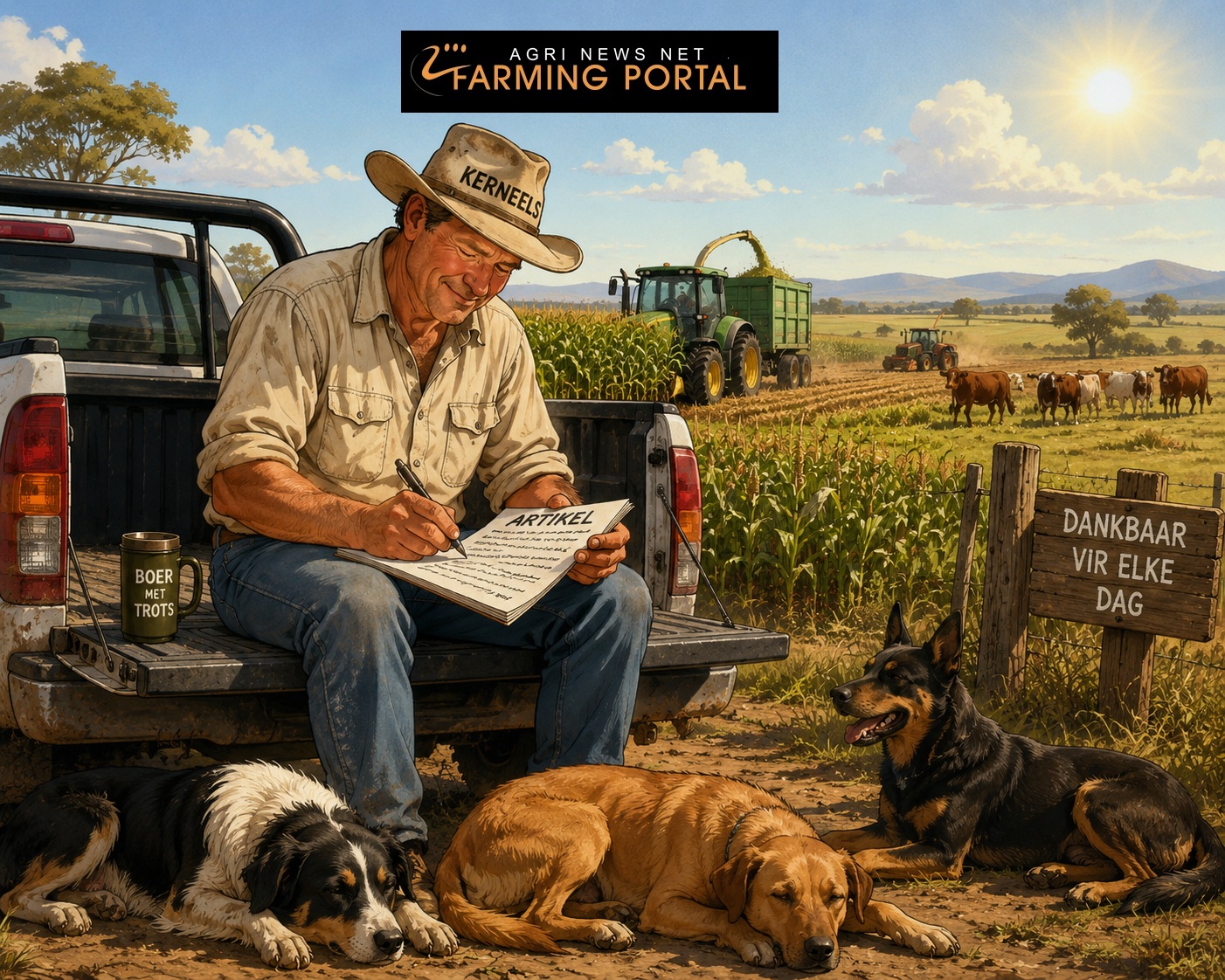
OOM KERNEELS
Van die Plaas af: Ek kan nie glo ons is al in die helfte van November nie. Die tyd loop nou vinnig verby.Toe ek nog op die skoolbanke gesit het, was ’n periode baie lank en ’n dag ook. Nou voel dit vir my of ons tyd al vinniger loop. En daar verloor die Springbokke teen die Franse hane- hulle het dalk te laat gespeel.
Ek sien hier ’n paar manne wat begin Kersfeeskoors kry, veral die manne en dames wat glo so hard werk in die korporatiewe wêreld. Dis meestal in hulle koppe. Hulle wil alles klaarmaak, terwyl ons op die plaas eers begin.
Ek en Gertrude was die week in Bloemfontein en die winkels is al vol Kersfees geskenke. Dit bly maar ’n wonder of daardie gewoonte nog gaan hou.
Dit was net so ’n warm week hier op die plaas. Die hitte en die westewind was erg, maar ek sien vandag kan ons dalk reën kry.
Die landbou is groot as dit kom by toekennings. Ek kan nie voorbly om te sien wie almal wen nie. En elke keer is dit ’n groot geleentheid om te eet en te drink en die borge betaal.
Ek lees dat daar nou onbekende kalwers in sekere voerkrale in Suid-Afrika aangekom het, sonder dat iemand weet waar dit vandaan kom. ’n Mens vra maar waar die kalwers vandaan kom, veral as ons in ’n land is waar bek-en-klouseer is.Die ander groot probleem wat ek sien, is die wild wat moontlik besmet kan raak. Elke dag gebeur hier iets wat vir ’n mens kommer.
Net soos met die munisipale verkiesing wat almal nou na mekaar vry. ’n Party wat omtrent geen stemme gekry het nie, wil nou vir die wenners vertel wat hulle moet doen, en daarmee saam hou hulle ook nie van die kandidate nie. Dit lyk meer vir my of hulle bang is hulle kan nie meer so steel as die mense in beheer is nie.
Ons gaan die week begin met mielies plant. Ons het verlede week so ’n proeflopie geneem. Ons ondervog is goed en nou moet ons kan waag. Die mielies sal opkom, maar ons moet duime vashou dat ons die Desember-Januarie deurgaan. Dit kan ons ook nie altyd reg voorspel nie.
Ek sien dat die man wat op sy plaas aangeval is, uit die hospitaal is, na soveel trauma. Dis nou verby en dis hoofsake en dan net tronkstraf. Maar ek hoor en sien niks wat gaan volg nie. Almal is nou stil tot daar weer een gebeur, en so gaan ons aan.
Die week was stelsels glo af en ’n mens kon nie aanlyn werk nie. Die wêreld draai om stelsels en die jong boere glo alles wat hulle op ’n app lees. As daardie app af is, dan moet jy jou eie "gutfeeling" gebruik. Ek is baie bly dat ek deur al die fases gekom het en weet hoe om werk goed "manual" te doen. Hieroor gesels ek op ’n ander dag.
Dis al geruime tyd wat ek ons mense dophou Baie van ons boere (en plattelandse mense in die algemeen) spandeer ure, geld en liefde om hulle bakkies, trekkers en implemente blink en in top-kondisie te hou. Die masjiene kry die beste olie, die regte bande, gereelde diens… maar die eienaar self sit op bloeddrukpille, cholesterolpille, suikerpille, hartpille, en soms nog ’n handvol ander. Dit is ironies, né? Die ding wat die plaas moet laat loop (die mens) word dikwels die swakste onderhou.
Ek en Gertrude gaan nou by ’n vriend kuier. Geniet jou res van die week. Bly wakker, en wees bedag, en moenie terugstaan nie.
Groete uit die Vrystaat- en ons hoop die week is daar water- uit die hemel
Tot volgende week.
Mag julle almal ’n lekker week he ons gesels weer. OOM Kerneels.

NS -We normally do not post sponsored or external videos on our professional platforms. However, videos of this nature — which are non-marketing and informative — are not freely available YouTube channels. We will soon have our own Professional Video Channel form our own Production house.
 \\


