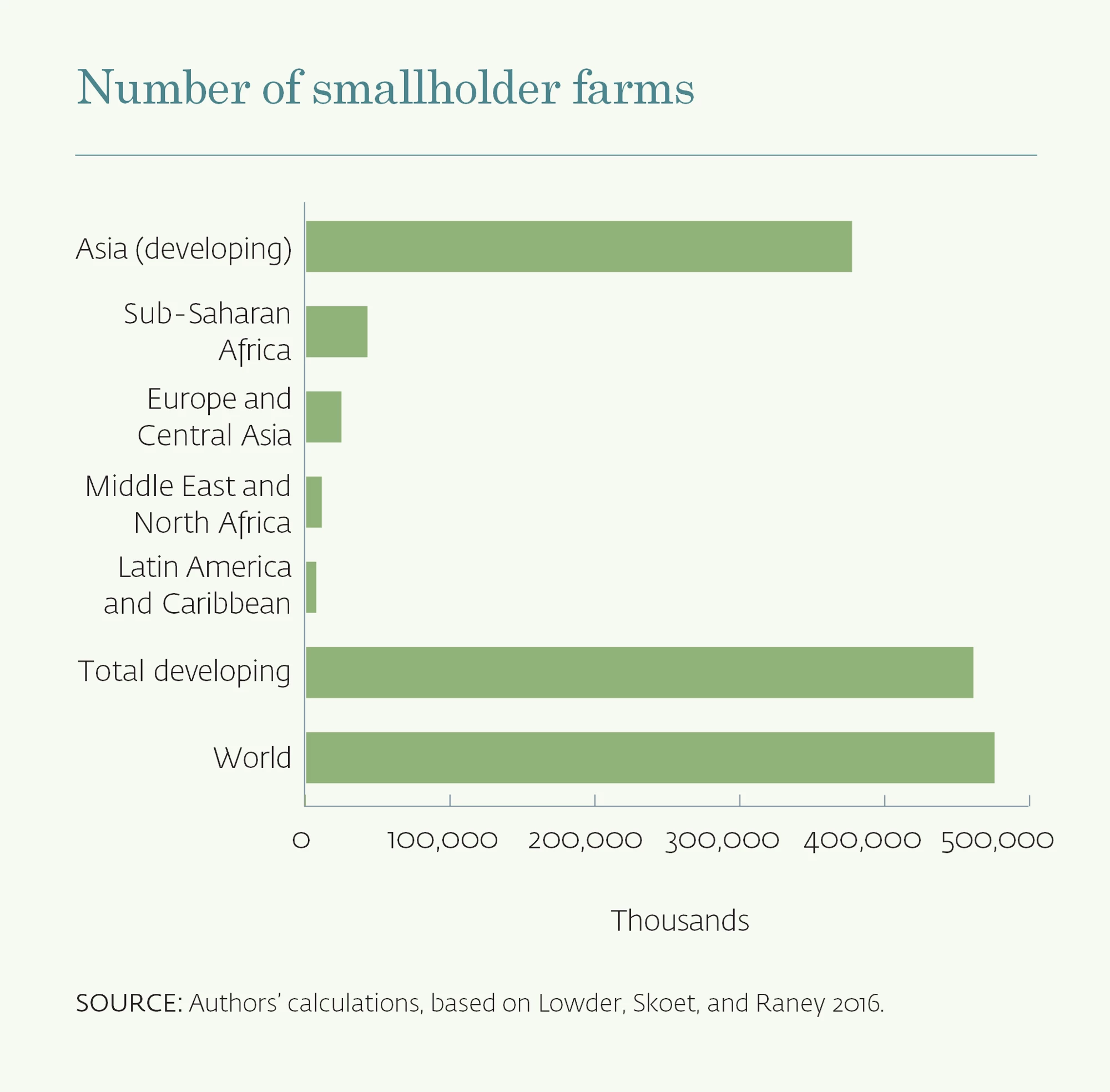








Family farmers and smallholders produce 80 percent of the world’s food. Among them are half a billion small producers, the majority women, who form the backbone of the food sector across low- and middle-income countries.
Yet, smallholder farmers – and the agricultural firms they own – are disproportionately impacted by climate change. Extreme weather events have almost doubled in frequency over the past 40 years, contributing to declining productivity, new pests and diseases, and volatility in prices and supply. By 2050, this is expected to result in a 94–111 percent price increase for wheat alone. Adapting to these risks requires changes in farming practices and investment, but smallholder farmers face a $172 billion funding gap, making them arguably the world’s largest group of financially underserved people. Initiatives like AgriConnect aims to help 300 million smallholder and family farmers access services, markets, and finance.
Finance is needed to help farmers adapt and invest in resilience. Our recent World Bank Group report, Silent Adapters: Uncovering the Resilience of Smaller Firms in Developing Countries, examines how smaller firms are adapting to climate change and how they are paying for it. Adaptation can involve changes in processes or the introduction of climate-resilient products and inputs. Examples include crop diversification, drip irrigation, cold chain storage, resilient seeds, mist cooling, or changes in animal feed, fertilizers, equipment use, and livestock breeds. This is smart development in action: these investments can improve yields, create jobs and drive growth while also building resilience and reducing emissions.
 AI offers promise for agriculture, but smallholder farmers risk being left behind
Access to credit is necessary for adaptation in agriculture, yet agricultural firms in emerging markets and developing economies face barriers to accessing finance. Their cash flows are limited and seasonal, collateral is scarce, and agricultural production is exposed to weather-related risks, pests and diseases, and price volatility. These factors increase their risk profile. About 60 percent of farmers are not commercial or integrated into supply chains and rely on informal and social lending. For lenders, serving small, remote, and often informal borrowers also entails higher transaction costs. In lower-income regions, underdeveloped payments markets and the prevalence of cash transactions can further impede agricultural value-chain finance.
Given the scarcity of long-term adaptation finance, innovative short-term financing can help smaller firms fund climate-smart agriculture. Smaller agricultural firms often combine different lending approaches, including trade finance, asset-based finance like factoring and warehouse receipts, or a mix of both—such as contract farming or buyer-backed equipment leasing. Pay-as-you-go financing models have allowed millions to acquire solar home systems, water heaters, and irrigation pumps, paying flexibly according to usage. In some sectors, such as livestock and agroforestry, carbon markets are also emerging as a source of finance for adaptation investments.
Aggregation and bundled services can improve access to finance. Grouping smaller agricultural firms can lower lending costs, while combining finance with non-financial services such as training increases adaptation effectiveness. Digital technology can also connect farmers directly with markets, service providers, and aggregators, increasing profitability and efficiency.
Financial products can help farmers and lenders manage climate risk. Lines of credit, first-loss schemes, and partial credit guarantees have been used to manage risk and crowd in private finance. In Bangladesh, BRAC offered farmers guaranteed access to emergency loans, triggered automatically by climate index data. Farmers had no upfront payment and only paid if they borrowed after a flood. The added security encouraged them to expand their crop production despite climate risks. Most farmers suffered no flooding and never needed the credit but saw 36 percent higher yields because of the higher investment. Those affected by floods were better able to cope with the shock.
Insurance can complement short-term crop finance for smaller agricultural firms by reducing risks for both farmers and lenders. It supports access to credit, boosts technology adoption, and increases productive investment and can drive adaptation, provided it is integrated into a broader risk-reduction strategy. In Haiti, for example, natural-disaster insurance has been bundled with microcredit, providing borrowers with loan-balance reimbursement and access to new credit after a covered shock. Shocks can disrupt lending to farmers after a disaster, increasing losses, and delaying recovery. But risk can also discourage lending and investment before disasters even happen. Insurance can help address both problems by reducing systemic weather-related risks for lenders. However, the use of insurance against climate and disaster risks in developing countries remains limited. High costs, low take-up, limited distribution networks, poor product design, and a lack of products tailored to smaller agricultural firms continue to constrain the market.
Closing the adaptation financing gap will require more than expanding the supply of conventional credit. Financial products need to be designed around the realities smaller agricultural firms face – seasonal cash flows, compounding risks – while reducing the cost of reaching them. Done well, finance can help farmers invest in resilience before the next shock hits, rather than scrambling to recover after it.